 AtticShield

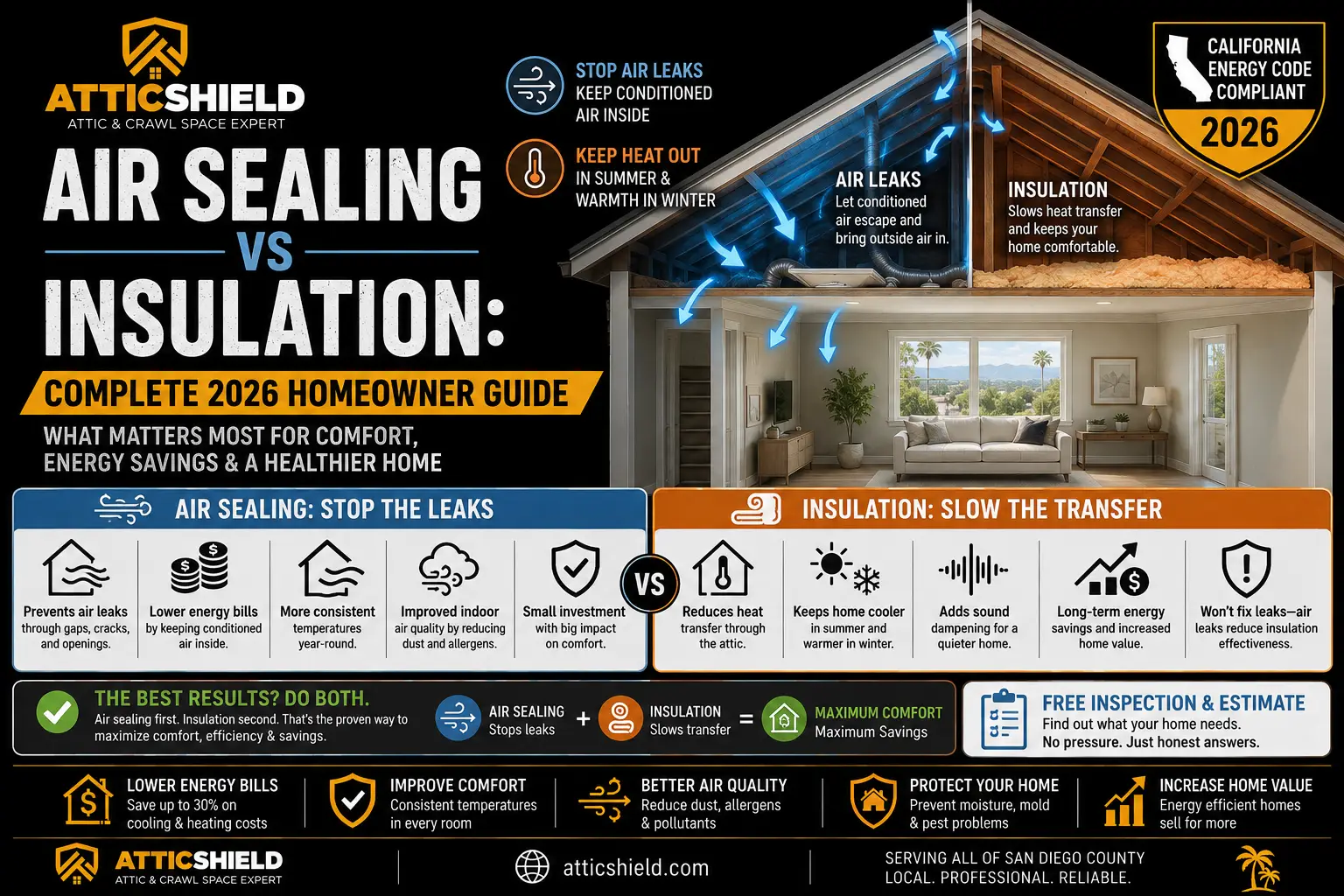
The air sealing vs insulation question comes up on nearly every attic inspection we do, usually phrased as: “can’t I just add more insulation?” You can. It’s often the wrong first move, and understanding why will save you money.
These two upgrades get bundled together in conversation as if they’re variations on the same thing. They aren’t. They solve different physical problems, and one of them is quietly undoing the other in most homes.
Here’s the short version before the long one.
The verdict, up front
Air sealing usually comes first, and it’s the cheaper of the two. Insulation slows heat moving through material. Air sealing stops air moving around it. Adding insulation over an unsealed ceiling means paying for performance you won’t fully receive — and it makes proper sealing far more expensive later, because the insulation has to come back up.
The right answer in most homes isn’t one or the other. It’s both, in the correct order, in the same project.

What’s in this guide
- What each one actually does
- Head-to-head comparison
- Why insulation alone underperforms
- What air sealing actually involves
- What an insulation upgrade involves
- When insulation genuinely comes first
- Why the order costs you twice if you get it wrong
- Why they’re cheaper done together
- What each costs — the short version
- How to tell what your house needs
- California-specific considerations
- How they compare to other upgrades
- 7 common mistakes
- Frequently asked questions
Air Sealing vs Insulation: What Each One Actually Does
Heat gets into and out of your home three ways. Insulation and air sealing each handle different ones, and neither covers all three.
Insulation handles conduction
Conduction is heat moving through solid material — through drywall, through framing, through the insulation itself. A 145°F attic sitting above a 75°F room creates constant pressure for heat to move downward through the ceiling. Insulation is a resistance layer that slows that transfer. R-value is literally a measure of resistance.
What insulation does not do is stop air. Fiberglass is not an air barrier. Air passes through it readily — that’s why it has to be paired with something that stops air movement to work as intended.
Air sealing handles convection and infiltration
Air carries heat with it. When cooled air escapes upward through gaps in your ceiling, it takes the cooling you paid for with it, and hot attic air gets pulled down through other gaps to replace it. This is a continuous cycle, and it runs all day whether or not your HVAC is on.
According to an ENERGY STAR air sealing fact sheet, air leakage accounts for roughly 25% to 40% of the energy used for heating and cooling — and it also reduces the effectiveness of other efficiency measures, including added insulation.
That second half is the part most homeowners never hear. Leakage doesn’t just cost energy on its own. It degrades what your insulation is capable of delivering.
Air Sealing vs Insulation: Head to Head
| Factor | Air sealing | Adding insulation |
|---|---|---|
| Problem it solves | Air leakage, drafts, stack effect | Conducted heat through the ceiling |
| Relative cost | Lower | Higher |
| Comfort improvement per dollar | Usually highest | High |
| Effect on dust entering the home | Significant reduction | Little to none |
| Effect on odor from the attic | Significant reduction | Little to none |
| Effect on HVAC runtime | Reduces | Reduces |
| Visible when finished | No — gets covered | Yes |
| Must be done first? | Yes, in nearly every case | No — it goes on top |
| Cost if done in the wrong order | 60%–100% of the work again | No penalty |
| Required by Title 24 on its own | Addressed as part of compliance | Yes, R-value minimums apply |
Air sealing is the priority when
- You feel drafts or temperature swings between rooms
- Dust builds up unusually fast
- You smell the attic inside the house
- There are many recessed lights in upstairs ceilings
- Existing insulation is already at or near code depth
- The home has an open floor plan with tall ceilings
Insulation is the priority when
- Insulation is at or below the top of the joists
- Rooms are hot in summer and cold in winter equally
- The attic has never been upgraded since construction
- Insulation is compacted, flattened, or patchy
- Coverage is missing entirely in some areas
- A previous contractor already air sealed properly
Most homes we inspect need both. The list on the left is usually the more urgent one, and if your attic also shows signs of rodent activity or moisture, cleaning and sanitizing move ahead of both — you cannot seal or insulate over contamination and expect either to perform.
Why Adding Insulation Alone Underperforms
Homeowners who add insulation without sealing frequently report the same thing: some improvement, but far less than they expected. There are four specific reasons.
1. Fiberglass does not stop air
Blown fiberglass and batts are air-permeable. Air moves through them. Piling more of an air-permeable material over an air leak does not close the leak — it puts a filter over it. The air still moves; it just picks up fibers on the way.
2. Convective looping inside the insulation
When there’s a temperature difference across a loose insulation layer, air circulates within the material itself — warm air rising through it, cooler air sinking. This convective movement carries heat past the resistance the R-value promised. It’s worst in low-density installations and at the edges of the attic.
3. Thermal bypass at the gaps
Every unsealed penetration is a direct path from conditioned space to attic. A gap that represents a tiny fraction of your ceiling area can account for a large share of your total heat exchange, because air moves heat far faster than conduction does. This is why “95% coverage” is not 95% performance.
4. You’ve just buried the fix
The practical consequence. Once 14 to 18 inches of blown insulation is down, the ceiling plane is invisible and inaccessible. Sealing it later means moving or vacuuming out insulation, doing the sealing, then re-blowing. You pay for the sealing plus most of the insulation labor a second time.
What Air Sealing Actually Involves
“Air sealing” sounds vague until you see the target list. It’s specific, physical work at identifiable locations.
| Target | Why it leaks | How it’s sealed |
|---|---|---|
| Top plates | Gap where interior walls meet the ceiling, open the full length of every wall | Foam or caulk along the seam |
| Recessed can lights | Housings are perforated by design; older ones are not airtight | Sealed covers, or replacement with IC-rated airtight fixtures |
| Plumbing stacks | Oversized holes cut for pipes | Fire-rated foam or collars |
| Wiring penetrations | Drilled holes larger than the cable | Fire-rated sealant |
| HVAC boots and registers | Gaps where ducts meet the ceiling | Mastic and sealant at the boot |
| Bath and kitchen fans | Housing gaps, and fans venting into the attic instead of outside | Sealed at housing, re-vented to exterior |
| Attic access hatch | Usually an uninsulated, unsealed panel | Weatherstripping plus a rigid insulated cover |
| Chimney and flue chases | Large open shafts, code requires clearance from combustibles | Metal flashing with high-temperature sealant |
| Dropped soffits and bulkheads | Open cavities above kitchen cabinets and closets | Rigid board sealed at edges |
The top plates and the dropped soffits are the ones homeowners never think about, and they are frequently the largest openings in the entire ceiling. Details in our attic air sealing service page and our complete air sealing guide.
What an Insulation Upgrade Involves
The other half of the air sealing vs insulation comparison. An insulation upgrade is more than blowing material in — done properly it includes preparation that determines whether the R-value on the invoice is the R-value you actually get.
- Assessment of existing material. Depth, type, condition, contamination. This determines whether removal is needed.
- Baffles at the soffit vents. Without them, blown insulation packs against the eaves and chokes off intake ventilation.
- Blocking around heat-producing fixtures where required for clearance.
- Depth markers installed so the finished depth is verifiable rather than claimed.
- Even coverage to the target R-value, including the difficult perimeter where attics get shallow.
What R-value to target
California’s Title 24 Building Energy Efficiency Standards set the minimum. For most of San Diego County that’s R-38.
| Target | Depth | Status | Who it’s for |
|---|---|---|---|
| R-38 | ≈13.25 inches | Code minimum | Coastal homes, tighter budgets |
| R-44 | ≈15 inches | Recommended | Most homes — best value |
| R-49 | ≈16.5 inches | Recommended — inland | Inland heat, hot upstairs rooms |
Depths are for blown-in fiberglass; cellulose reaches the same R-values at less depth.
We recommend R-44 as the default rather than stopping at code, for the same reason the order of operations matters: once a crew is in the attic with the equipment staged and the setup paid for, the added depth is mostly material cost. You’re buying performance without buying the labor twice. More in our Title 24 guide and our California climate zone map, which shows why coastal and inland homes land on different targets.

When Insulation Genuinely Comes First
The general rule has real exceptions, and a contractor who applies it rigidly to every house isn’t paying attention.
- The attic has almost no insulation at all. If there are bare patches of drywall visible, conduction is dominating everything else. Sealing still happens first within the same project, but insulation is the headline fix.
- Somebody already sealed it properly. If a previous project sealed the ceiling plane and documented it, adding depth is the remaining work.
- The ceiling plane is genuinely inaccessible. Some attics — very low clearance, or fully ducted — have areas that can’t be reached for sealing. Insulation may be the only practical improvement in those zones.
- Budget forces a phase. If you can only do one thing this year and your attic has R-11, insulation delivers more than sealing alone would. Just know that sealing later will cost more than sealing now.
The honest version of that last point. Phasing is legitimate when money is tight. But ask specifically what the later sealing will cost after insulation is down, and get that number before you decide. Sometimes the answer changes the plan — it can be cheaper to do a smaller scope correctly now than a larger scope that needs redoing.
Why the Wrong Order Costs You Twice
Certain sequences in attic work cannot be reversed without paying for the reversal. This is the practical core of the air sealing vs insulation question.
| Done later instead of now | What has to be undone | Rough added cost |
|---|---|---|
| Air sealing after insulation | Insulation vacuumed or moved to expose the ceiling, then re-blown | 60%–100% of the sealing cost, again |
| Duct repair after insulation | Insulation disturbed along every duct run | 30%–40% more |
| Rodent proofing after insulation | Entry points buried; crew compacts fresh material working over it | 30%–50% more |
| Sanitizing after insulation | Cannot be done properly — new material must come out | Effectively a full redo |
| Baffles after insulation | Perimeter insulation pulled back and replaced | Moderate |
Notice that insulation appears on the right side of every row. That’s not a coincidence — insulation is the last layer, so anything it covers becomes expensive to reach.
Why They’re Cheaper Done Together
Beyond the sequencing penalty, there’s a straightforward economic reason to combine them: a large share of what any attic job costs has nothing to do with either service.
- Crew and truck committed to your address for the day
- Equipment staged, hoses run from the truck into the attic
- Floor, stair, and hallway protection through your home
- Containment at the attic access
- Temporary lighting and decking inside the attic
- Teardown, cleanup, and haul-away
That happens once whether the crew performs one service or five. Book air sealing and insulation as separate projects and you pay for it twice — while also triggering the sequencing penalty above.
This is why a bundled quote often has a lower per-item cost than the same services quoted individually. It isn’t a discount; it’s the actual structure of the work. We break the math down further in our attic insulation cost guide.
What Each One Costs — the Short Version
The proportion is what matters here more than the totals: air sealing typically runs a fraction of what insulation does, and it often delivers the larger share of the comfort improvement. That’s the whole reason it leads this comparison.
One anchor figure for orientation: on a typical attic around 1,200 square feet, air sealing and an insulation upgrade done together usually land in the $2,800 to $5,200 range — with the sealing portion being the smaller slice. Doing them separately costs more than doing them together, and sealing retrofitted after insulation is the expensive scenario this whole article exists to help you avoid.
Every attic prices differently — size, access, clearance, and condition all move the number. For the complete breakdown of every service, what moves prices up and down, and why bundled scopes cost less per item, see our attic insulation cost guide. A free inspection is what turns ranges into a real number for your home.
Find out which your attic needs — and in what order
Free inspection with photos of your actual attic, insulation depth measured, penetrations identified, and a written estimate that separates necessary from optional.
Request a free inspection or call (858) 402-0066How to Tell What Your House Needs
Five checks you can run yourself
- Measure insulation depth against the joists. Ceiling joists are typically 8–10 inches. If insulation is level with or below the top of them, you’re well under code and insulation is a real need.
- Look for dark streaks or discolored patches in the insulation. Those mark where air has been moving through it, filtering dust as it goes. Dirty insulation is a map of your air leaks.
- Count the recessed lights in upstairs ceilings. Each one is a potential leak. A dozen or more strongly suggests sealing is your priority.
- Notice how fast dust returns after cleaning. Unusually fast dust accumulation points at air infiltration, not insulation.
- Smell test. If you can smell attic — dust, must, or worse — inside the house, air is moving from there to here.
If you would rather not go up at all, that is reasonable — this is what a free inspection is for. Checks 2, 4, and 5 all point at sealing. Check 1 points at insulation. If you’re seeing several at once, you need both, which is the most common outcome.
If you go up to look, be careful. San Diego attics regularly exceed 140°F from late spring through October. Go early in the morning, never alone, and step only on joists. Heat exhaustion in an attic is a genuine emergency, and stepping between joists puts you through the ceiling.
California-Specific Considerations
Mild climate does not mean low stakes
A common misreading of San Diego’s climate is that the envelope matters less here. Attic temperatures say otherwise — 130°F to 150°F on summer afternoons, with the heat radiating downward for hours after sunset. The load is cooling-dominated rather than heating-dominated, but it’s still a load.
Title 24 compliance
California’s energy code addresses both insulation R-value minimums and building envelope tightness. Requirements vary by jurisdiction and project scope. A licensed C-2 contractor will know what applies to your city and your specific work.
Sealing and ventilation have to be balanced
Air sealing targets the ceiling plane — the boundary between conditioned space and attic. Attic ventilation is a separate system that moves outside air through the attic itself. These are not in conflict, and sealing the ceiling does not mean sealing the attic.
Getting this wrong in either direction causes problems: an unsealed ceiling wastes energy, and a poorly ventilated attic traps heat and moisture. Both get addressed in the same project.
Ducts in the attic
Most San Diego homes run ductwork through the attic, which makes duct leakage a third factor alongside air sealing vs insulation. ENERGY STAR’s duct guidance is specific on method — mastic sealant or metal tape, never duct tape, which fails over time. The EPA also identifies duct leakage as a contributor to indoor pollutant levels, since return-side leaks pull unfiltered attic air into the living space.
Verify the license
Insulation work in California requires a C-2 Insulation and Acoustical Contractor license. A general B contractor cannot legally perform it. Check any contractor’s number at the CSLB license portal before signing. More in our guide on how to check a contractor license.
How These Compare to Other Home Upgrades
Homeowners weighing air sealing vs insulation are often weighing both against something else entirely — new windows, a roof, a heat pump. Here’s roughly where each sits on cost and comfort return.
| Upgrade | Relative cost | Comfort return | Worth doing first? |
|---|---|---|---|
| Attic air sealing | Low | High | Yes — usually the best starting point |
| Attic insulation upgrade | Moderate | High | Yes, alongside sealing |
| Duct sealing and repair | Low to moderate | High if ducts leak | Yes, while the attic is open |
| Duct insulation | Low to moderate | Moderate to high | Yes, with duct work |
| Wall insulation (blow-in) | Moderate | Moderate | After the attic |
| Replacement windows | High | Low to moderate | Rarely first |
| New HVAC equipment | High | Varies | Only if equipment is failing |
| Cool roof / re-roof | Very high | Moderate | When the roof needs replacing anyway |
Windows get the most marketing attention and typically deliver the least comfort per dollar in a cooling-dominated climate, because the ceiling is where most of the heat exchange happens. We compare attic and wall assemblies in attic insulation vs wall insulation.
The sequencing logic also extends beyond the attic. If your home has a crawl space, that’s a separate environment with its own setup, so bundling it with attic work saves scheduling rather than labor. Worth doing, but it doesn’t share the same economics.
7 Common Mistakes
1. Adding insulation over contaminated material. If there’s rodent waste, moisture, or heavy compaction underneath, covering it traps the problem and delivers a fraction of the expected performance.
2. Treating fiberglass as an air barrier. It isn’t one. Stuffing insulation into a gap does not seal it.
3. Sealing the soffit vents by accident. Blown insulation packed into the eaves chokes intake ventilation. Baffles prevent it, and they have to go in before the insulation.
4. Skipping the attic hatch. It’s frequently the single largest uninsulated, unsealed opening in the entire ceiling, and it’s the cheapest one to fix.
5. Using duct tape on ducts. It fails. Mastic or metal tape, per ENERGY STAR guidance.
6. Buying R-value without verifying depth. An invoice saying R-38 means nothing if the finished depth is 9 inches. Depth markers make it verifiable. Ask for after-photos showing them.
7. Deciding between air sealing vs insulation as an either/or. The framing itself is the mistake. They address different physics, and in most homes the right answer is both, sequenced correctly, in one project.

Frequently Asked Questions
Air sealing vs insulation — which should I do first?
Air sealing, in nearly every case. It costs less, it addresses a problem insulation cannot touch, and it becomes far more expensive once insulation covers the ceiling plane. The exception is an attic with almost no insulation at all, where both are urgent and both should happen in the same project.
Can I skip air sealing if I add a lot of insulation?
No. Fiberglass is air-permeable, so air continues moving through it. Per ENERGY STAR, air leakage accounts for roughly 25% to 40% of heating and cooling energy, and it also reduces the effectiveness of added insulation. More depth over an unsealed ceiling buys you less than the R-value suggests.
How much does air sealing cost compared to insulation?
Air sealing typically runs $0.55 to $1.30 per square foot, versus $1.80 to $2.90 for blown insulation. Sealing is usually 20% to 30% of a combined project, and often delivers the larger share of the comfort improvement.
Will air sealing make my house too tight?
In an existing home, essentially never. Retrofit sealing addresses the largest, most wasteful openings — it does not produce a sealed box. Newly built homes are constructed to much tighter standards and include mechanical ventilation for that reason.
Does air sealing help in summer or just winter?
Both, and in a cooling-dominated climate like San Diego the summer benefit is the one you feel. Every gap in your ceiling is a path for cooled air out and 145°F attic air in, running all day.
How do I know if my attic was already air sealed?
Look for evidence at the penetrations: foam or caulk at top plates, sealed covers over recessed lights, collars around plumbing stacks, a weatherstripped hatch. If insulation is already down and you see none of that at the visible edges, it likely wasn’t done.
Is spray foam a way to do both at once?
It does combine air barrier and insulation in one material, which is why it gets marketed heavily. It also costs two to three times fiberglass, complicates future roof inspection and leak detection, and creates moisture considerations many homeowners aren’t told about. We explain our position in why spray foam isn’t the best choice for residential homes.
How long does the combined work take?
Air sealing plus an insulation upgrade is often a single day. Add removal, sanitizing, or rodent proofing and it typically becomes two.
Get Both Assessed at Once
The air sealing vs insulation debate resolves differently in every attic, because it depends on what’s actually up there — insulation depth, condition, number of penetrations, duct routing, and whether anything has contaminated the space.
Attic Shield inspects attics across San Diego County, Southwest Riverside County, and South Orange County. You get photographs of your actual attic, measured insulation depth, an identified list of leak points, and a written estimate that tells you what’s necessary, what’s optional, and what order it belongs in.
Free attic inspection, no obligation
Photos, measurements, a written estimate, and a straight answer about what your attic actually needs.
Request your free inspection or call (858) 402-0066Attic Shield is licensed, bonded, and insured. CSLB #1138021, C-2 and B classifications. See our full service area across San Diego, Escondido, Carlsbad, Temecula, and surrounding communities.