 AtticShield

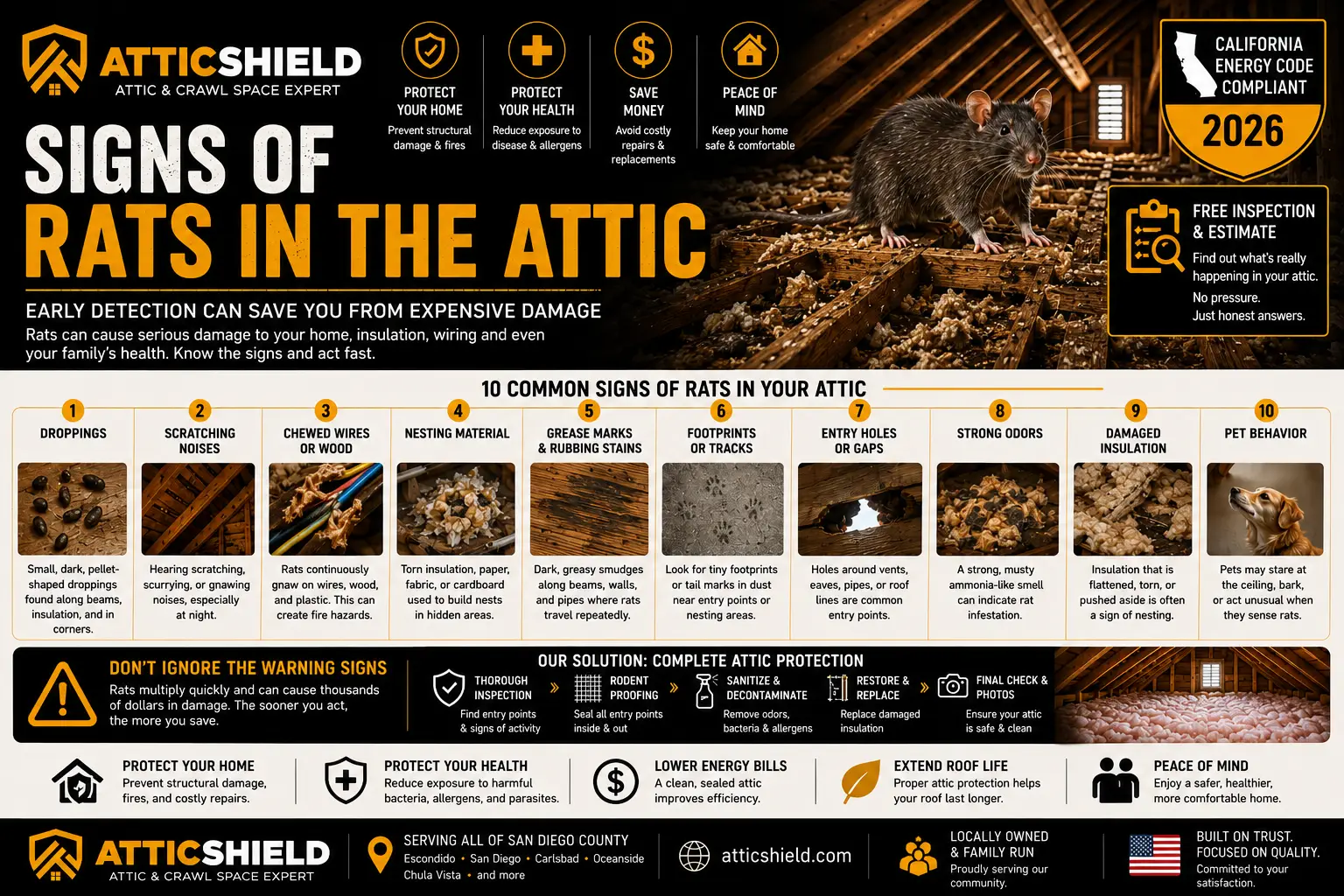
Rats in the attic rarely stay secret for long — they leave a trail of sounds, smells, and physical evidence that’s unmistakable once you know how to read it. The problem is that most homeowners don’t know how to read it, so the average infestation runs for months before anyone acts. This guide covers every sign, how to confirm what you’re dealing with, and why the response order matters more than the response speed.
Southern California context matters here: our dominant attic rodent is the roof rat — an agile climber that reaches rooflines by way of trees, fences, and utility lines, and treats a warm, quiet, insulated attic as ideal real estate. Mild winters mean there’s no off-season. If your neighborhood has mature trees, palms, or fruit trees — most of San Diego County does — your attic is on the market year-round.

What’s in this guide
- Sign 1: the sounds — and what time they happen
- Sign 2: droppings — the definitive evidence
- Signs 3–10: the full evidence list
- How to confirm it in one evening
- Why they chose your attic
- What they’re doing up there right now
- The typical infestation timeline
- What a professional sees
- 5 responses that make it worse
- What actually works: the exclusion-first sequence
- Keeping them from coming back
- Frequently asked questions
Sign 1: The Sounds — and Why the Clock Matters
Noise is how most people first learn they have rats in the attic, and the details of the noise carry real diagnostic information.
| What you hear | When | What it suggests |
|---|---|---|
| Scurrying, quick footfalls across the ceiling | First hours after dark; again before dawn | Classic rat activity pattern — leaving to forage, returning to nest |
| Gnawing — a rhythmic scraping or grinding | Night, often sustained | Rats actively chewing wood, plastic, or wiring; the sign that should worry you most |
| Rolling or dragging sounds | Night | Nesting material or food being moved |
| Light, fast skittering in walls | Night | Could be mice rather than rats — see our roof rats vs mice guide |
| Heavy thumping, slow movement, daytime activity | Day or dusk | Possibly a larger animal — possum, raccoon — which changes the response |
| Fluttering, cooing near vents | Dawn/day | Birds at a vent opening — still an opening that needs sealing |
The timing is the tell. Rats are strongly nocturnal, most active in the first couple of hours after the house goes quiet. Sounds that start like clockwork around bedtime, localized to the ceiling over particular rooms, are the signature. And gnawing deserves its own emphasis: a rat’s front teeth grow continuously, so chewing isn’t optional behavior — and attic wiring insulation is, unfortunately, a satisfying thing to chew. That’s the fire-risk pathway, and it’s the reason “we’ll deal with the noise later” is a more expensive sentence than it sounds. We covered how that escalation compounds in the true cost of ignoring attic problems.
Sign 2: Droppings — the Definitive Evidence
Sounds can be ambiguous. Droppings aren’t. If you find them, the question stops being “do we have them?” and becomes “how established are they?”
- What they look like: dark, spindle-shaped pellets roughly the size of a grain of rice or a bit larger, often with pointed ends. Fresh droppings are dark and soft-looking; old ones turn gray and crumbly. Both matter — fresh means active now, old means the attic has history.
- Where to look: along the attic perimeter, near the water heater or furnace platform if you have one up there, around penetrations, and on top of insulation in “runway” lines. Rats are creatures of habit; they travel the same routes, so evidence concentrates in lanes.
- Quantity reads as time: a scattering suggests recent arrival; accumulations and layers suggest an established population that’s been there through multiple generations.
Do not vacuum or sweep droppings. The CDC’s rodent guidance is explicit that dry sweeping and vacuuming can aerosolize contaminants from rodent waste. Identification is a flashlight job from a distance. Cleanup is a containment-and-equipment job — which is what professional rodent waste removal and sanitization exists for.
Signs 3 Through 10: The Full Evidence List
3. Grease marks and rub trails
Rats have oily fur and poor eyesight; they navigate by hugging edges and repeating routes. Over weeks, that leaves dark, greasy smudges along beams, pipes, entry holes, and wall lines — a physical map of their commute. A grease-ringed opening is a confirmed door.
4. Tunneled and flattened insulation
Rats burrow through loose insulation the way commuters use roads, leaving visible trenches, packed runways, and dished-out nesting bowls. This is also where the damage bill starts: tunneled insulation loses its loft, and urine-soaked material can’t be cleaned — only replaced. Our guide on how rodents destroy insulation R-value covers the mechanism, and when to replace attic insulation covers the decision.
5. Gnaw marks
Paired incisor grooves on wood framing, plastic pipes, stored boxes, and — the serious one — wiring insulation. Fresh gnawing shows pale, clean wood; old gnawing darkens. Any gnaw evidence near wiring moves the urgency up a category.
6. The smell
An ammonia-like odor — sharp, uriney, unmistakable once you’ve smelled it — that’s strongest at the attic hatch and after warm days. Established infestations announce themselves this way even when nothing has been seen or heard. A dead-animal odor localized to one area is its own version of the same message.
7. Nests
Balls or pockets of shredded material — insulation, paper, fabric, plant matter — packed into corners, eave bays, and the gaps beside stored items. Finding one usually means there are more.
8. Pets acting strange
Dogs and cats hear and smell what you can’t. A pet that stares at the ceiling, tracks something across it, or fixates on a wall or the attic hatch is running better detection equipment than you are. It’s not proof — but paired with any other sign, take it seriously.
9. Evidence outside the house
Droppings along fence tops and garage edges, gnawed fruit on citrus trees, and rustling in palms or ivy at dusk all indicate pressure around the property. Roof rats commute along fences and branches like highways — activity on the routes predicts activity at the destination.
10. Sightings at dusk on wires and rooflines
Seeing a rat travel a utility line or fence top toward your roof at dusk is watching the commute happen. One visible rat implies more you’re not seeing — rats are social, and the visible one is rarely alone.
How to Confirm It in One Evening
The homeowner confirmation kit — no crawling required
- The listening session. Tonight, turn everything off 30 minutes after your normal bedtime quiet. Note what you hear, when it starts, and which rooms it’s over. Repeat tomorrow — rats run schedules.
- The hatch check. In the morning (attics are dangerously hot later — see below), open the hatch, and before looking, smell. Then flashlight-scan from the opening: droppings, runways in the insulation, grease at penetrations. Do not walk the attic; everything on this list is visible from the hatch.
- The perimeter walk. Outside, scan the roofline for gaps, lifted vent screens, and openings where pipes and cables enter. Per CDC guidance, a rat needs a gap of only about half an inch — a quarter is a generous door. Check where trees, fences, and wires approach the roof.
- The flour test (optional). A light dusting of flour near the hatch or a suspected runway, checked after two nights, records footprints and tail drags — cheap, harmless motion capture.
Attic safety, every time. Southern California attics regularly exceed 140°F from late spring through fall. Morning checks only, never alone, and stay at the hatch. If you see heavy contamination or suspect anything larger than rats is living up there, close the hatch and make the call — that’s exactly what a free inspection is for.
Why They Chose Your Attic
Attic rats aren’t bad luck — they’re the predictable result of three things lining up:
- Access routes. Branches within jumping distance of the roof, fence lines that dead-end at the eaves, utility wires, climbing vines, and stacked storage against exterior walls. Roof rats are exceptional climbers; anything touching or near the roofline is a ramp.
- Openings. Unscreened or torn vents, gaps at rooflines and eave returns, openings around pipe and cable penetrations, and deteriorated construction gaps. Half an inch is enough.
- Reasons to stay. Warmth, quiet, soft insulation for nesting, and nearby food — pet food, fallen fruit, bird feeders, open trash. The attic is the bedroom; your yard is the kitchen.
This is also why the fix is structural rather than chemical: you can remove individual rats forever, but as long as the routes, openings, and reasons remain, the vacancy gets filled. Neighborhoods from La Mesa and El Cajon to Escondido and Vista — anywhere with mature landscaping — carry standing roof rat pressure that never takes a season off.
What They’re Doing Up There Right Now
While the decision to act gets deferred, four meters are running:
- Insulation destruction. Tunneling collapses loft; urine saturates material that can never be cleaned, only removed. The energy bill absorbs this daily.
- Contamination accumulation. Droppings and urine build up, and per the CDC, rodent waste is a health matter requiring careful handling — not a cleanup you improvise with a shop vac.
- Wiring risk. Continuous gnawing plus electrical wiring is the combination that turns a rodent problem into a fire conversation.
- Population growth. Rats reproduce quickly, with multiple litters a year under good conditions — and your attic is good conditions. Every month of delay makes the eventual job bigger, a curve we mapped stage by stage in the cost of ignoring attic problems.
The Typical Timeline: How an Infestation Actually Unfolds
Homeowners consistently underestimate how established their situation is, because the evidence arrives gradually and each stage normalizes the last. Here’s the pattern we reconstruct over and over from inspection evidence:
- Weeks 1–2: scouting. A rat finds the route and the opening. Evidence: almost none — perhaps one faint noise dismissed as the house settling. This is the cheapest moment in the entire timeline, and nobody ever catches it.
- Weeks 2–6: move-in. Regular nightly sounds begin, on a schedule. First droppings appear along what will become permanent runways. Most homeowners are now aware something is happening — and most decide to wait and see.
- Months 2–4: establishment. Nesting bowls form in the insulation. Grease marks darken at entry points. The first litter arrives, and the sounds multiply. The smell begins on warm days.
- Months 4 and beyond: the colony. Multiple generations, saturated insulation zones, gnawing damage accumulating — including, in the worst cases, wiring. This is where most calls actually happen, at the most expensive point on the curve.
The lesson isn’t guilt — it’s arithmetic. Every stage of waiting converts a smaller job into a larger one, which is the entire thesis of our guide on what deferral costs. If you recognize your house in weeks 2–6, you’re in the best position a homeowner with rats in the attic can be in.
What a Professional Sees That You Can’t
The homeowner confirmation kit above answers whether. A professional inspection answers how bad, where from, and what order — which are the questions the fix is actually built from:
- Dropping age analysis. Fresh versus faded droppings, layered accumulations, and their distribution tell an inspector whether activity is current, historical, or both — which changes whether removal precedes exclusion.
- The complete entry map. Rats in the attic typically use several openings, not one. Finding the obvious torn vent screen and missing the grease-ringed gap at the eave return is how “sealed” houses get re-infested. The exterior pass with a trained eye is the difference.
- Contamination extent. How far urine saturation has spread through the insulation determines the line between spot removal and full insulation replacement — a call that meaningfully changes scope, and one that needs the whole attic examined, not the view from the hatch.
- Secondary damage screening. Gnaw evidence near wiring and duct damage get specifically checked, because they’re the findings that change urgency.
All of it arrives as photos of your actual attic — the standard we described in what to expect from a free attic inspection.
5 Responses That Make Rats in the Attic Worse
1. Poison in the attic. The most common DIY move and the most regretted. Poisoned rats die inside walls and inaccessible cavities, producing weeks of odor and fly problems — and poison does nothing about the openings, so new rats replace the dead ones. Secondary poisoning of owls, hawks, and pets is a real regional concern on top of it.
2. Sealing the holes while rats are still inside. Exclusion is the answer, but sequence matters: seal every opening with the population still in residence and you’ve trapped animals that will now chew new exits — or die in the structure. Removal and exclusion have to be coordinated.
3. A couple of traps and a declaration of victory. Trapping two rats from an established colony is a rounding error. Without exclusion, trapping is a subscription, not a solution.
4. Ultrasonic repellers and mothballs. Rats habituate to sound devices quickly, and repellent smells don’t overcome the value of a safe, warm nest. There’s a reason these products have no role in professional exclusion work.
5. Cleaning the mess but keeping the doors open. Removing contamination without sealing entry points schedules the same job again. The scent trails plus open access are an invitation with a map attached.
What Actually Works: the Exclusion-First Sequence
The permanent fix for rats in the attic is structural, and it runs in a specific order because each step protects the next:
- Full inspection with photos. Every entry point found — roofline, vents, penetrations, eave returns — plus contamination mapped and insulation condition assessed. Partial entry-point lists produce repeat infestations.
- Removal of the current population, coordinated with the sealing schedule so nothing gets locked inside.
- Exclusion: every opening sealed with rodent-resistant materials — metal mesh, sealants, and screening rated for teeth that never stop growing. Vents get screened, not blocked, so your attic ventilation keeps working.
- Waste removal and contaminated insulation removal under containment, followed by sanitization that neutralizes bacteria, odor, and the pheromone trails that would otherwise advertise the vacancy.
- Air sealing and new insulation — the rebuild step, done while the deck is clear, which is exactly when it’s cheapest. The full economics of bundling these are in our attic insulation cost guide.
- After-photos and warranty. You should be able to see the sealed openings and the restored attic, not take anyone’s word for it.
Notice what this sequence is: it’s the same once-in-decades access window we describe throughout this site, triggered by a rodent event. Homeowners who go through it properly typically end up with a better-performing attic than they had before the rats arrived.
Keeping Them From Coming Back
- Trim the highways. Keep branches well clear of the roofline, and thin dense ivy and palm skirts — the standard guidance is to break the bridge, not just shorten it.
- Manage the food yard. Pick up fallen fruit, feed pets indoors, secure trash lids, and rethink bird feeders during active pressure.
- Re-check screens yearly and after wind events. A torn vent screen is a door; Santa Ana winds are good at making them.
- Listen seasonally. Do the bedtime listening session a couple of times a year — it’s free and it catches stage one at stage one.
- After any roof or solar work, verify. Trades create openings and displace screens more often than anyone expects.
Frequently Asked Questions
How do I know if I have rats in the attic or something else?
Timing and weight of the sounds: rats produce quick scurrying and gnawing starting shortly after dark; mice are lighter and faster, often in walls; heavy thumping or daytime activity suggests a larger animal. Droppings settle it — rice-grain-size or larger, spindle-shaped pellets are rats. Our roof rats vs mice guide covers the distinctions in detail.
Will rats in the attic go away on their own?
No. An attic offers everything a roof rat wants — warmth, quiet, nesting material, and safety — and Southern California’s climate removes the seasonal pressure that pushes rodents out elsewhere. Populations grow; they don’t wander off.
How fast should I act on the first signs?
Quickly — not because one night matters, but because the cost curve bends with establishment. Early-stage exclusion is minor work; established-colony restoration involves removal, sanitization, and insulation replacement. The signs you noticed this week are the cheapest this problem will ever be.
Is it safe to clean up rat droppings myself?
Small, incidental amounts can be handled following CDC precautions — no sweeping or vacuuming, wet-clean with disinfectant, gloves and ventilation. Accumulations, contaminated insulation, and nest material are professional territory with containment and proper equipment.
Do rats in the attic mean my house is dirty?
Not remotely. Roof rats select for access and shelter, not housekeeping. Mature trees near the roofline are a stronger predictor than anything inside your home.
Does homeowner’s insurance cover rodent damage?
Policies commonly treat rodent damage as excluded maintenance-related damage, though specifics vary — check your policy directly. It’s one more reason early action beats deferral.
Get a Definitive Answer This Week
Every sign in this article is visible to a professional inspection in under an hour — entry points, activity level, contamination extent, and insulation condition, all documented with photos. You’ll know exactly what’s up there, how established it is, and what the right-order fix looks like, separated into what’s urgent and what can be bundled later.
Free attic inspection, no obligation
Photos of your actual attic and a straight answer about what’s living up there. Serving San Diego County, Southwest Riverside County, and South Orange County.
Request your free inspection or call (858) 402-0066Attic Shield is licensed, bonded, and insured. CSLB #1138021, C-2 and B classifications. See our full service area.