 AtticShield

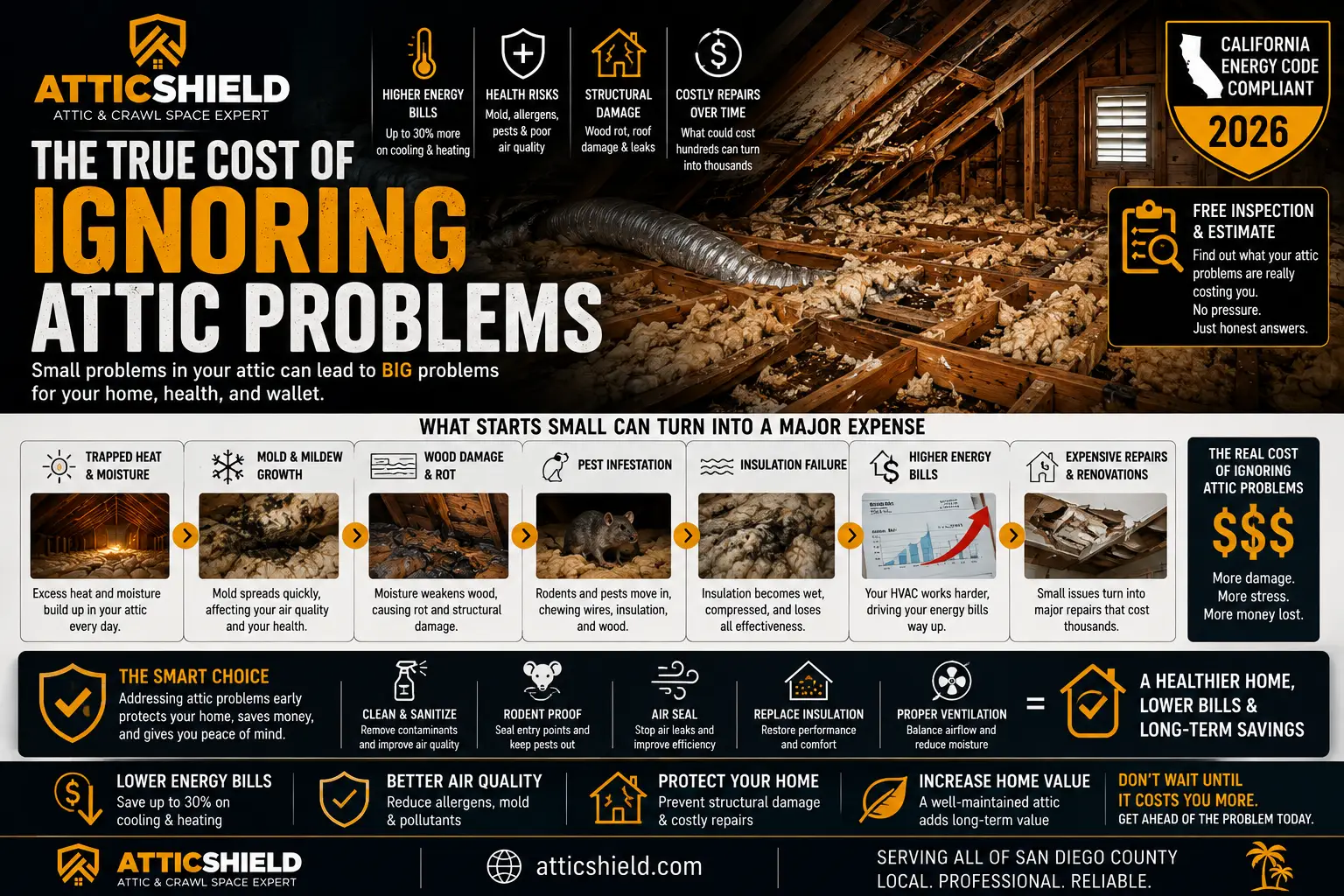
Ignoring attic problems feels free. The attic is out of sight, the door stays closed, and nothing up there sends a bill this month. But attic problems have a property most home issues don’t: they compound. A gap becomes an entry point, an entry point becomes a nest, a nest becomes contaminated insulation, and a $300 fix becomes a five-figure restoration — while quietly charging you rent the whole time through your energy bill.
This guide follows the actual escalation paths — what small problems become, on what timeline, and at what multiple of the original cost. It also does the opposite of what you’d expect from a contractor’s blog: it names the attic problems that genuinely can wait, because credibility matters more to us than urgency.

What’s in this guide
- Why attic problems compound instead of waiting
- Escalation path 1: the rodent timeline
- Escalation path 2: the moisture timeline
- Escalation path 3: the silent energy meter
- Escalation path 4: your HVAC pays the tax
- The air you’re breathing meanwhile
- The bill that arrives at escrow
- What genuinely CAN wait
- Why smart people defer anyway
- Why it costs more in SoCal
- The intervention math
- The 15-minute yearly habit
- Frequently asked questions
Why Ignoring Attic Problems Doesn’t Pause Them
To understand why ignoring attic problems is different from other deferred maintenance, start with the shape of the cost. Most deferred home maintenance is roughly linear. A scuffed wall this year is a scuffed wall next year; the repaint costs about the same whenever you do it. Attics don’t work that way, for three structural reasons:
1. The attic is an ecosystem, not a surface. It has temperature swings, moisture flows, air pressure differentials, and — in Southern California — constant pressure from roof rats looking for exactly the conditions your attic offers. Problems up there interact. A ventilation problem feeds a moisture problem feeds a mold problem. A gap feeds a rodent problem feeds an insulation problem feeds an air quality problem.
2. Damage converts categories. The most expensive attic jobs aren’t big versions of small jobs — they’re different jobs. Sealing a gap is exclusion work. A year later, the same gap requires exclusion plus waste removal plus insulation replacement plus sanitizing. The original task is still in there; it just acquired three more.
3. It bills you while you wait. Degraded insulation and leaking ceiling gaps don’t wait politely for repair — they run your meter every single day. Per EPA and ENERGY STAR estimates, air sealing plus proper attic insulation saves an average of about 15% on heating and cooling costs — which means an attic in poor condition is forfeiting that amount continuously, before any repair cost is even counted.
Escalation Path 1: The Rodent Timeline
The most common and most expensive path in Southern California, so it goes first. Roof rats need a gap about the size of a quarter; mice need less.
An opening exists
A lifted vent screen, a gap at the roofline, an opening around a pipe or cable penetration. Fixing it now is minor exclusion work — among the smallest line items in this entire trade. Nothing has been damaged yet.
Occupancy
Scratching at night, droppings appearing, insulation being tunneled into runways and pulled into nests. Now the job is exclusion at all entry points plus waste removal and sanitizing. The insulation may still be salvageable if this stage is caught early.
Establishment
Generations of nesting. Urine saturation through the insulation layer, pheromone trails recruiting new arrivals, chewed wiring risk, odor reaching the living space. The insulation is now unsalvageable — this is the full restoration: removal, sanitizing, exclusion, air sealing, and new insulation. Our guide on how rodents destroy insulation R-value covers the mechanism.
Secondary damage
Chewed electrical wiring is a fire risk with a cost ceiling nobody can quote. Ducts gnawed open pull contaminated attic air into your HVAC. This stage is why stage 1 is the only good place to be on this timeline.
The maddening part: the stage-1 fix and the stage-3 fix address the same original gap. Everything between them is the price of the wait.
Escalation Path 2: The Moisture Timeline
Slower than rodents, quieter, and the one coastal homeowners in Carlsbad, Oceanside, and Encinitas should respect most.
| Stage | What’s happening | What fixing it involves |
|---|---|---|
| 1. A moisture source exists | Small roof leak, bathroom fan venting into the attic, blocked ventilation intake trapping humid air | Fix the source — a fan re-vent, baffles, a flashing repair |
| 2. Insulation absorbs it | Material mats down, loses R-value, holds dampness against the ceiling | Source fix + affected insulation removed and replaced |
| 3. Biology arrives | Staining and growth on sheathing, musty odor migrating downstairs | Source fix + removal + remediation + replacement |
| 4. Structure pays | Sheathing delamination, framing damage, roof repairs | Everything above + roofing/structural trades |
Each row down roughly multiplies the row above it — and the stage-1 fix is frequently one of the cheapest tasks on any attic work order. A bathroom fan venting into the attic is a small correction that prevents the entire table below it.
Escalation Path 3: The Silent Energy Meter
This path never escalates dramatically — it just never stops charging. According to U.S. Energy Information Administration data, heating and cooling are the largest share of residential energy use, and in Southern California cooling dominates it. An attic with thin, compacted, or gapped insulation and an unsealed ceiling plane leaks a share of every cooling dollar, every day, indefinitely.
Run the compounding honestly: a household forfeiting even a modest monthly amount to a degraded attic pays it twelve times a year, every year, with utility rates trending in one direction. Over the five to ten years a typical homeowner “gets around to it,” the forfeited energy alone can approach the cost of the fix that would have stopped it — and that’s before counting comfort, the hot upstairs bedrooms, and the HVAC wear in the next section.
The Department of Energy puts the attic first on its list of where to insulate for exactly this reason: it’s where the biggest continuous losses live.
Escalation Path 4: Your HVAC Pays the Tax
Every hour your system runs against a leaky, under-insulated attic is an hour of wear it didn’t owe. Compressors, blower motors, and capacitors have lifespans measured in operating hours — a system fighting a bad attic accumulates those hours dramatically faster.
- Longer runtimes, more cycles — the system works harder to hold temperature and still loses the upstairs
- Earlier replacement — years shaved off a five-figure piece of equipment
- Dirtier operation — return-side duct leaks in the attic pull dust and fibers through the system continuously
- The oversizing trap — when the old unit dies early, it often gets replaced with a bigger one to “fix” the comfort problem, which short-cycles and makes the upstairs worse. The attic was the problem the whole time.
An honest HVAC contractor and an honest attic contractor will tell you the same thing: fix the envelope before you size the equipment.
The Air You’re Breathing Meanwhile
The costs above are financial. This one isn’t, and it’s the reason “later” deserves more scrutiny than it gets.
The attic and your living space are supposed to be separate air zones. In a home with an unsealed ceiling plane and leaky attic ducts, they aren’t — air moves between them constantly. Whatever is in the attic participates in your indoor air: dust, insulation fibers, and, where rodents have been active, contaminants from droppings and nesting material. The EPA identifies duct leakage as a meaningful contributor to indoor pollutant levels, and the CDC’s rodent guidance explains why rodent waste is treated as a health matter, not a mess.
This is most worth taking seriously in the rooms where people sleep eight hours a night — which, in a two-story home, are the rooms directly under the attic.
The Bill That Arrives at Escrow
For homeowners planning to sell, ignoring attic problems has a known arrival date for its bill: the buyer’s inspection. Deferred attic problems have a known arrival date: the buyer’s inspection.
Inspectors open attic hatches. Contaminated insulation, rodent evidence, moisture staining, and missing coverage all go in the report — and repair items discovered during escrow get priced by the buyer’s contractor, negotiated under deadline pressure, and routinely settle as credits larger than what the work would have cost done calmly beforehand. Worse, “rodent activity” in an inspection report spooks buyers in a way a completed, documented restoration never does.
We wrote a full guide for this exact situation: fix these attic issues before your buyer’s inspection. The short version: the attic gets paid for either way; sellers only choose whether to pay retail or escrow-panic pricing.
What Genuinely CAN Wait
Here’s the section that makes the rest of this article believable. Not every attic imperfection is an emergency, and a contractor who treats them all as one is selling urgency, not judgment.
Low-urgency items — monitor, bundle into your next project
- Clean insulation that’s merely below modern depth. If it’s dry, uncontaminated, and intact, you’re losing efficiency, not safety. Top it off when you’re ready — ideally bundled with air sealing so you only pay for setup once.
- Ordinary dust and old construction debris. Unsightly, not urgent. Handle it during the next real project.
- A slightly under-vented but dry attic. If there’s no moisture evidence and no severe heat complaint, ventilation improvements can ride along with insulation work rather than justify their own visit.
- Minor compaction at the hatch and walkways. A localized issue in an otherwise healthy attic. Note it, fix it with the next scope.
- Cosmetic aging. Discolored-but-dry batts, dated materials that still perform. Old is not broken.
The two that never wait: any sign of rodent activity, and any sign of moisture. Those are the two compounding paths. Everything else on the list above is linear — it costs about the same next year. Those two do not.
Why Smart People Defer Anyway — and the Counter-Moves
None of this is news to most homeowners, so it’s worth being honest about why ignoring attic problems remains the default anyway. The reasons are psychological, and each has a practical counter.
“Out of sight” is a real force. The attic doesn’t appear in daily life. A cracked kitchen tile gets fixed because it’s seen forty times a day; a rodent runway above the master bedroom is seen zero times a year. Counter-move: the yearly checklist below — a fixed date on the calendar substitutes for visibility the attic will never provide.
The bill is invisible because it’s distributed. Nobody receives an invoice labeled “attic inefficiency.” The cost arrives smeared across twelve utility bills, an HVAC unit that died in year eleven instead of sixteen, and an escrow credit years from now. Counter-move: compare this August’s electric bill to the same month three years back. That drift is the invoice.
Fear of the number keeps the hatch shut. Some homeowners avoid the inspection specifically because they’re afraid of what it will cost — which is precisely backwards, since the number only grows while nobody looks. Counter-move: remember the “what can wait” list above. Inspections routinely come back with more items in the can-wait column than the now column, and a documented healthy attic is worth having in a folder.
Quotes without inspection made the market feel dishonest. Homeowners burned by pressure sales assume every contractor visit ends in a scary pitch. Counter-move: insist on the things pressure-sellers can’t fake — photos of your actual attic, a written scope that separates necessary from optional, and a license you can verify. Our guide on checking a California contractor license takes five minutes and filters most of the bad actors.
Why Ignoring Attic Problems Costs More in Southern California Specifically
The escalation paths in this article run everywhere, but three regional factors compress the timelines here:
- Roof rat pressure is year-round. Mild winters mean no seasonal die-back; mature landscaping, palms, and fruit trees in neighborhoods from La Mesa to Vista keep populations high and searching. Stage 1 becomes stage 2 faster here than in colder markets.
- The cooling season is long and getting longer. A degraded attic bills you for more months of the year than it would elsewhere, and inland attics in Escondido and El Cajon exceeding 140°F magnify every insulation and duct deficiency. We covered the climate trend in San Diego County’s changing climate.
- Coastal moisture never takes a season off. Marine-layer humidity works on under-vented coastal attics all year, which is why the moisture timeline deserves particular respect west of the 5.
The Intervention Math
One number for orientation, consistent with our full pricing guide: a typical mid-sized attic’s combined air sealing and insulation project — the flat yellow line above — commonly lands around $2,800 to $5,200. Stage-3 rodent restorations run at a multiple of that, and stage-4 outcomes have no reliable ceiling. The complete breakdown of every service and what moves prices is in our attic insulation cost guide.
The 15-Minute Yearly Habit That Prevents All of This
Once a year — spring is ideal, before attic temperatures peak
- Listen for a week. Scratching or scurrying at night, especially in ceilings and walls, is the earliest rodent signal you’ll get.
- Open the hatch and smell. Ammonia points to rodents; must points to moisture. Either one means call someone now, at stage 1 prices.
- Flashlight scan from the hatch. Droppings, tunnels, staining on the sheathing, insulation depth versus the joists. No crawling needed — our insulation self-check guide walks it step by step.
- Walk the exterior. Roofline gaps, lifted or torn vent screens, openings around pipes and cables — quarter-sized or larger is a door.
- Check two registers upstairs. Weak or warm airflow versus downstairs points at attic duct problems.
- Glance at your summer bills year-over-year. A drift upward with no rate change is the meter telling you something the hatch will confirm.
Attic safety, as always. Southern California attics exceed 140°F for much of the year. Morning checks only, never alone, joists only — and this checklist is built so you never have to leave the hatch. If you’d rather not go up at all, that’s literally what a free inspection is for.
Frequently Asked Questions
What happens if you keep ignoring attic problems?
They compound rather than wait. Rodent and moisture issues convert into bigger job categories — a sealed gap becomes a full restoration — while degraded insulation and air leaks charge you continuously through energy bills and HVAC wear. The two paths that escalate fastest are rodents and moisture; most everything else is roughly linear.
How do I know if my attic has a problem right now?
Night noises, any odor from the hatch, droppings, staining, a chronically hot upstairs, or drifting energy bills. The 15-minute checklist above covers it from the hatch — or a free professional inspection documents everything with photos.
Are rodents in the attic really that serious?
Yes, on three fronts at once: they destroy insulation performance, their waste is a health matter per CDC guidance, and chewed wiring is a fire risk. It’s also the single problem where early action changes the price most — exclusion at first signs versus full restoration after establishment are different orders of magnitude.
Do attic problems affect home value?
Directly, at inspection time. Attic findings during escrow become repair credits negotiated under deadline pressure, typically costing more than the same work done beforehand — and rodent findings spook buyers beyond their dollar cost.
What attic issues are safe to postpone?
Clean-but-thin insulation, ordinary dust, minor localized compaction, and modest ventilation shortfalls in a dry attic — all linear problems that can wait for a bundled project. Rodent signs and moisture signs are the two that should never wait.
How often should an attic be checked?
Once a year from the hatch, plus after any roof work, solar installation, or major storm — trades in the attic displace insulation and create gaps more often than homeowners expect.
Find Out What’s Actually Up There
The entire economics of this article comes down to one fact: attic problems are cheap exactly once — at the beginning — and the beginning is only visible to someone who looks.
Attic Shield’s free inspection documents your attic with photos: insulation condition and depth, rodent evidence, moisture signs, ventilation, sealing, and duct condition. You get a written scope separating what needs doing now, what can be bundled later, and what’s fine — the same honest split as the “what can wait” section above. If your attic is healthy, you’ll hear exactly that, and you’ll have the photos to prove it at your next home sale.
Free attic inspection, no obligation
Catch it at stage 1 — or confirm you have nothing to catch. Serving San Diego County, Southwest Riverside County, and South Orange County.
Request your free inspection or call (858) 402-0066Attic Shield is licensed, bonded, and insured. CSLB #1138021, C-2 and B classifications. See our full service area including Escondido, San Diego, Temecula, and Poway.