 AtticShield

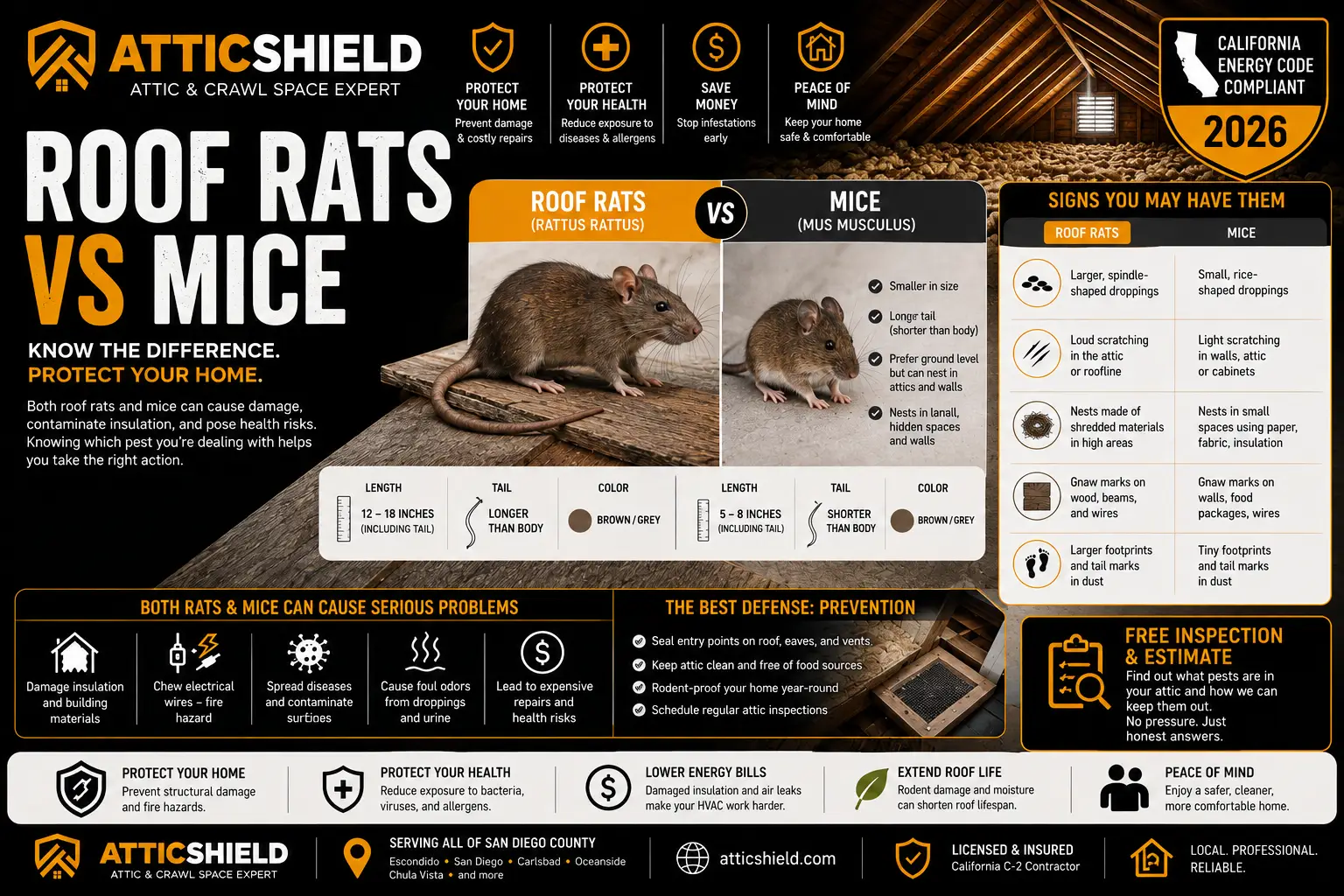
Roof rats vs mice isn’t academic trivia — it’s the first question that decides how your attic problem gets fixed. The two animals enter through different-sized openings, travel different routes, nest in different places, and defeat different exclusion strategies. Treat a roof rat problem like a mouse problem and you’ll seal the wrong holes at the wrong height and wonder why the noises came back.
The good news: you can usually make the identification yourself, from evidence, without ever seeing the animal. This guide gives you every distinguishing sign, in order of reliability.

What’s in this guide
- The two animals, briefly
- The master comparison table
- Droppings: the most reliable evidence
- Sounds and behavior
- Entry points: half an inch vs a quarter inch
- How each one gets in
- The third possibility: Norway rats
- Seasonal patterns in SoCal
- Which is worse to have?
- How the fix differs
- What’s identical either way
- Frequently asked questions
Roof Rats vs Mice: the Two Animals, Briefly
The roof rat
Southern California’s signature attic rodent. Sleek and agile, with a tail longer than its body, large ears, and a pointed snout. An exceptional climber that lives up — trees, fences, utility lines, rooflines — which is exactly why your attic, not your basement, is where it settles. Adults run notably larger than mice, with body lengths several times a mouse’s.
The house mouse
Small — a body a few inches long — with proportionally large ears and a light build. Curious where rats are cautious, mice explore new objects readily. They exploit tiny openings, live closer to their food than rats do, and are more likely to spread through wall voids and lower levels in addition to the attic.
In our service area, the attic answer is usually roof rats — the climbing lifestyle plus Southern California’s mature landscaping makes attics their natural habitat, a pattern we see across San Diego, Escondido, Temecula, and everywhere in between. But “usually” isn’t “always,” and getting it right changes the work, so identify before you act.
Roof Rats vs Mice: the Master Table
Every roof rats vs mice question in this guide reduces to the rows below — bookmark this table and most identifications settle themselves.
| Evidence | Roof rat | House mouse |
|---|---|---|
| Droppings | Spindle-shaped, ~½ inch, pointed ends; scattered along travel routes | Much smaller, ~⅛–¼ inch, rod-like; abundant — mice drop constantly |
| Sounds | Distinct footfalls, deliberate scurrying across the ceiling; audible gnawing | Faint, fast skittering and scratching, frequently inside walls |
| Minimum opening | About ½ inch — a quarter-sized hole is comfortable (CDC) | About ¼ inch — a dime-sized hole or a pencil-width gap (CDC) |
| Typical entry height | High: roofline, eaves, vents, utility penetrations upstairs | Any height: foundation gaps, garage door corners, and up through walls |
| Travel style | Fixed runways along edges and beams; leaves grease rub marks | Short-range wandering near nest; less pronounced rub marks |
| Range from nest | Travels far to forage — commutes outdoors nightly | Stays close — often lives within feet of a food source |
| Nesting | Bowls and pockets tunneled into attic insulation; also in palms and ivy outdoors | Small shredded-material nests in tight voids, stored boxes, wall cavities |
| Temperament | Neophobic — avoids new objects; can take days to approach a trap | Curious — investigates new objects quickly |
| Gnawing signature | Larger paired grooves; capable of serious structural and wiring damage | Fine, small gnaw marks; still a wiring risk, smaller scale |
Droppings: the Most Reliable Evidence
If you get only one piece of physical evidence, make it this one — droppings are diagnostic, durable, and safe to evaluate from a distance with a flashlight.
- Size settles it. Rat droppings approach the size of a grain of rice or larger — around half an inch — with a spindle shape and often pointed ends. Mouse droppings are dramatically smaller, an eighth to a quarter inch, like dark grains of orzo. Once you’ve seen both, they’re impossible to confuse.
- Quantity and pattern differ. Mice produce far more droppings and scatter them everywhere they travel, including inside cabinets and drawers when they’ve reached living spaces. Rats concentrate theirs along established runways and near nesting areas.
- Age reads as history. Fresh droppings are dark with a moist look; old ones fade gray and crumble. A mix of both means long-running activity.
Whichever animal it is: never sweep or vacuum droppings. The CDC’s rodent guidance warns that dry cleanup can aerosolize contaminants from rodent waste. Identify visually; leave disturbance and cleanup to containment methods — that’s the entire reason professional waste removal and sanitization exists as a service.
Roof Rats vs Mice by Sound: What the Ceiling Is Telling You
Sound is less definitive than droppings but it’s the evidence you get first, usually at bedtime.
- Weight comes through the drywall. A roof rat crossing your ceiling produces distinct, countable footfalls — you can track its route across the room. Mice read as a light, fast scratching or skittering that’s harder to localize.
- Location leans one way or the other. Sounds predominantly in the ceiling plane and attic suggest rats running their elevated lifestyle. Sounds inside walls, around the kitchen, and at lower levels lean mouse — they live close to food and spread through voids.
- Gnawing volume differs. Rat gnawing on framing is genuinely audible — a rhythmic grinding. Mouse gnawing is fainter and easily missed.
- Both are nocturnal, most active in the hours after the house quiets. Daytime heavy movement points to something larger — possum or raccoon — which is a different conversation entirely.
For the complete catalog of rodent evidence — grease marks, tunneled insulation, odor, and the one-evening confirmation routine — see our full guide to signs of rats in the attic.
Roof Rats vs Mice Entry Points: Half an Inch vs a Quarter Inch
Per CDC guidance, a rat can pass through a gap of about half an inch, while a mouse needs only about a quarter inch. That factor-of-two difference cascades through the whole exclusion job: a house sealed to rat standard can still be wide open to mice. It’s also why “we sealed some holes” so often fails — the standard isn’t some, it’s every opening above the threshold for the animal in question.
Roof Rats vs Mice: How Each One Gets In
The roof rat’s commute: aerial
- Tree branches overhanging or touching the roof — the number one route
- Fence tops and block walls that run to the house
- Utility lines — genuine tightrope walkers
- Climbing vegetation: ivy, bougainvillea, palm trunks with skirts
- Then in through: unscreened or torn vents, roofline gaps, eave returns, and penetrations — the same openings that compromise your attic ventilation when screens fail
The mouse’s route: ground-up and everywhere
- Foundation and stucco gaps, weep screed openings
- Garage door corners and the garage-to-house connection
- Gaps where pipes, cables, and AC lines enter walls
- Then upward through wall voids — which is how a “ground floor” mouse becomes an attic mouse
This is why a proper exclusion inspection walks the entire envelope — roofline to foundation — rather than just the attic. The evidence tells you which animal; the animal tells you where to look hardest.
The Third Possibility: Norway Rats
The identification question has a third answer worth knowing, even though it’s the least common one in Southern California attics: the Norway rat. Where roof rats are the slender aerialists of the rodent world, Norway rats are the heavyset ground crew — bulkier bodies, blunter snouts, smaller ears, and a tail shorter than the body rather than longer.
- They live low. Norway rats are burrowers — foundations, ground-level voids, sewers, and yards. Where roof rats enter at the eaves, Norway rats enter at the base of the structure.
- Their droppings differ too: larger and blunter-ended than the roof rat’s pointed spindles — a distinction an inspector uses alongside location of the evidence.
- Attic evidence usually still means roof rats here. In our service area’s attics, the climber dominates. But ground-floor and garage evidence with burrow activity outside shifts the answer — and shifts the exclusion plan down to grade level with it.
The practical takeaway doesn’t change: identify from evidence, then seal to the identified animal’s standard at the heights that animal actually uses.
Seasonal Patterns: When Each One Shows Up
Southern California’s mild climate means rodent pressure never drops to zero — but it does have rhythm, and knowing it helps you read a sudden change in your house:
- Fall through winter is peak move-in season. Even our gentle temperature drops push both rats and mice toward heated structures. The classic pattern: the first cool week of October, and the first scratching noises the same weekend.
- Roof rat pressure tracks the fruit. Citrus and other backyard fruit cycles feed outdoor populations; when a heavy fruit season ends, well-fed populations go looking for shelter. Neighborhoods with mature fruit trees see this most clearly.
- Mice respond to disturbance. Construction, landscaping tear-outs, and neighboring demolition displace ground-level mouse populations into adjacent homes — a new-noises-after-the-neighbor’s-remodel pattern we hear about regularly.
- Summer doesn’t mean safe. Established colonies don’t leave when it warms up — an attic that gained rodents in November still has them in July, plus two generations. Seasonality governs arrivals, not departures.
Whatever season you’re reading this in: current noise means current activity, and current activity means the identification-then-exclusion sequence is worth starting now rather than after the next move-in wave.
Roof Rats vs Mice: Which Is Worse to Have?
In the roof rats vs mice comparison, neither is good news — but they’re bad news differently:
- Per animal, rats do more damage. Bigger teeth, bigger appetite for gnawing, more insulation destroyed per nest, and audible structural chewing. Rat-scale tunneling is a leading reason attics end up needing full insulation replacement.
- Mice compensate with numbers and spread. Faster breeding at smaller scale, more droppings distributed more widely, and a habit of reaching kitchens and living spaces that attic-dwelling roof rats indulge less often.
- Health handling is serious either way. The CDC treats waste from both as requiring careful handling — the cleanup protocol doesn’t relax because the animal was small.
- Both compound with time. Whichever one you have, it’s running the same escalation curve we mapped in the cost of ignoring attic problems — and the cheapest day to fix it is the day you identify it.
Roof Rats vs Mice: How the Fix Differs
| Step | If it’s roof rats | If it’s mice |
|---|---|---|
| Inspection focus | Roofline, vents, eaves, tree/fence access routes | Full envelope, foundation to roof, garage connections |
| Sealing standard | Every opening ½ inch and larger, rodent-rated materials | Every opening ¼ inch and larger — a finer, more exacting pass |
| Trap strategy | Placed on runways, pre-baited patience for neophobic animals | More stations, tighter spacing near nest zones; curiosity works for you |
| Landscape work | Branch clearance from roof, thin ivy and palm skirts | Ground-level harborage: dense ground cover, wood piles, stored items at walls |
| Attic restoration | Identical for both: waste removal → contaminated insulation removal → sanitization → air sealing → new insulation | |
The mistake this table prevents: buying generic “rodent control” that traps a few animals and calls it done. Species-blind sealing to the wrong standard, at the wrong heights, is how homeowners end up paying twice. Identification first, exclusion built to the identified animal, restoration once — that’s the order that sticks. It’s the approach behind our rodent proofing service.
What’s Identical Either Way
For everything the species distinction changes, five things don’t move:
- Neither leaves voluntarily. A Southern California attic is prime habitat twelve months a year.
- Poison in the attic is the wrong move for both — dead animals in inaccessible cavities, no effect on openings, and secondary risk to owls, hawks, and pets.
- Exclusion is the permanent fix for both. Removal without sealing is a subscription.
- Contaminated insulation can’t be cleaned for either. Urine-saturated material comes out; the deck gets sanitized; new material goes in — with the once-exposed ceiling plane air sealed while it’s reachable, per the bundling economics in our cost guide.
- Verification beats assumption. Photos of the evidence and the sealed openings, before and after — for either species, that’s what “done” should look like.
Frequently Asked Questions
How do I tell roof rats vs mice without seeing the animal?
Droppings are the most reliable evidence: rat droppings run around half an inch with a spindle shape; mouse droppings are an eighth to a quarter inch and far more numerous. Sound weight is the second clue — countable footfalls suggest rats, faint skittering suggests mice.
Can the roof rats vs mice answer be “both”?
It happens, though rats tend to suppress mice where they overlap. Mixed evidence — two distinct dropping sizes, sounds at both ceiling and wall levels — is worth flagging to your inspector, because the exclusion then has to meet the finer mouse standard everywhere.
Why do I have rodents when my house is clean?
Because access, not cleanliness, drives it. Roof rats select for trees near the roofline and openings at the eaves; mice select for gaps and shelter. Housekeeping is barely a variable.
Do the noises at night mean a big infestation?
Not necessarily — one rat is audible. What noise does tell you is that activity is current, which makes it the cheapest possible moment to act. Confirmation steps are in our signs of rats in the attic guide.
Are mice in the attic less serious than rats?
Smaller-scale damage per animal, yes — but the health handling requirements are the same, the population grows faster, and mouse exclusion is actually the more demanding sealing job. “Just mice” is not a reason to wait.
Will sealing my house trap them inside?
It can, if done in the wrong order — which is why professional exclusion coordinates removal with sealing rather than closing everything at once. Sequence is most of what you’re paying for.
Get the Identification Done Right
Our free inspection settles roof rats vs mice definitively — evidence photographed, entry points mapped for the correct animal, contamination assessed, and a written scope in the right order: removal, exclusion to the correct standard, restoration once. If the evidence turns out to be old and the attic inactive, you’ll hear that too, with the photos to prove it.
Free attic inspection, no obligation
Know exactly what’s up there — and what it will take to make it permanent history. Serving San Diego County, Southwest Riverside County, and South Orange County.
Request your free inspection or call (858) 402-0066Attic Shield is licensed, bonded, and insured. CSLB #1138021, C-2 and B classifications. See our full service area.