 AtticShield

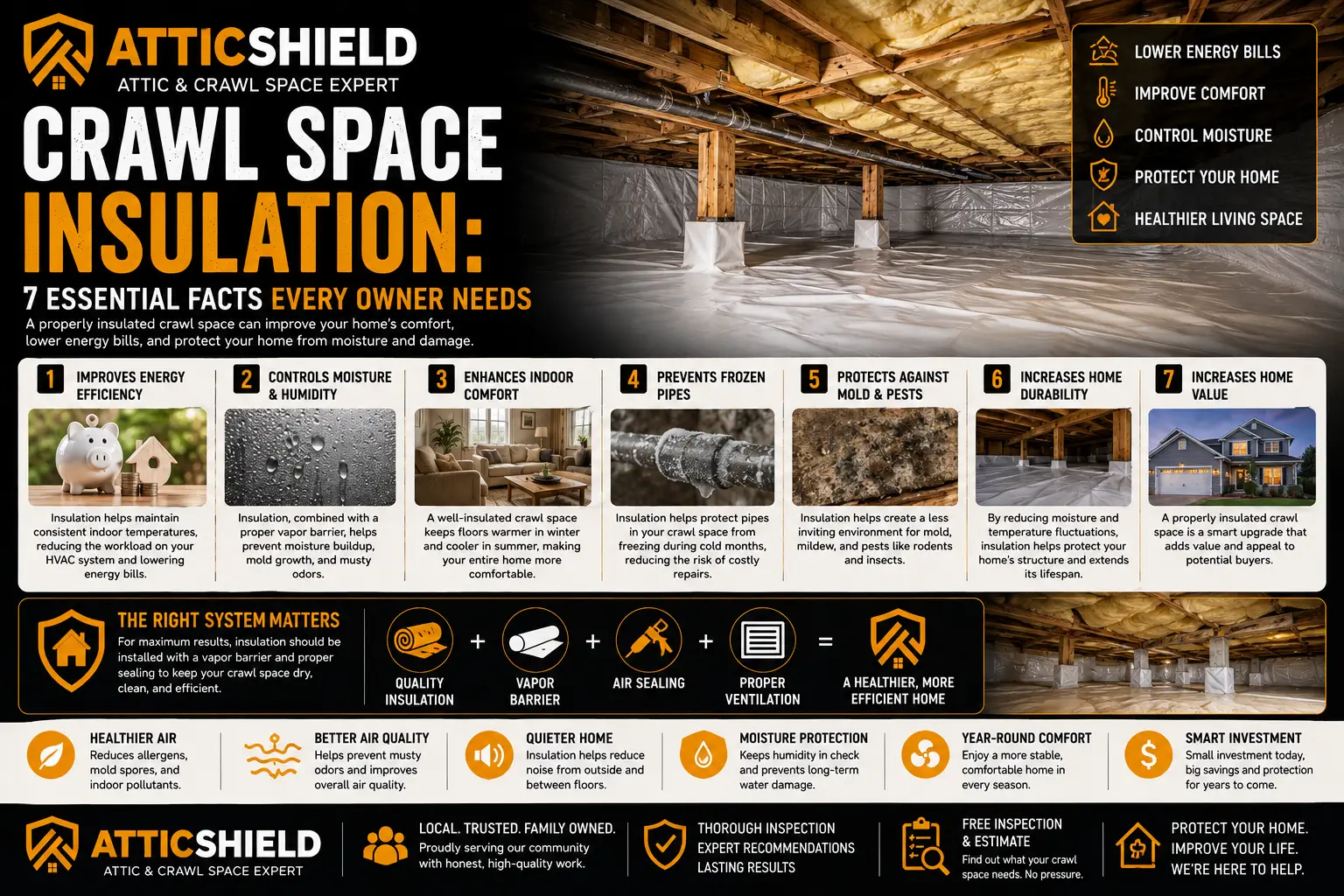
Crawl space insulation is the layer of thermal protection between your floors and the outside world — and in most Southern California homes with raised foundations, it’s in worse shape than any other insulation in the house. It sags, falls, soaks up moisture, and gets shredded by rodents, all in a space nobody looks at. This guide covers how crawl space insulation works, why it fails, how to tell what condition yours is in, and what proper replacement involves.
If your floors are cold in winter, your house smells musty in humid weather, or you’ve simply never once seen under your house — this is the missing chapter.

What’s in this guide
- What crawl space insulation does
- Where it goes: floor vs walls
- Why it fails — the big four
- 8 signs yours has failed
- What failure feels like upstairs
- Materials compared
- What proper replacement involves
- The right order: why prep comes first
- The energy math
- Southern California zone notes
- Frequently asked questions
What Crawl Space Insulation Actually Does
A raised-foundation home floats over an unconditioned pocket of outdoor air. Without insulation between your floor and that pocket, every room sits on a thermal bridge: winter cold and summer heat pass through the floor assembly directly into your living space, and your HVAC pays for the difference all year.
Crawl space insulation — typically fiberglass batts fitted between the floor joists, held against the subfloor — breaks that bridge. Done right, it delivers three things at once:
- Warmer floors in winter, cooler rooms in summer. The floor stops being a radiator for whatever temperature the crawl space is running.
- Lower HVAC load. The Department of Energy’s insulation guidance lists floors over unconditioned spaces among the key insulation zones in a home for exactly this reason.
- A quieter, more stable house. Insulated floor assemblies damp sound and temperature swings both.
The catch: crawl space insulation only delivers any of that while it’s in position and dry — and the crawl space environment attacks both conditions continuously.
Where Crawl Space Insulation Goes: Floor vs Walls
| Approach | What it is | When it fits |
|---|---|---|
| Underfloor (between joists) | Batts fitted into the joist bays against the subfloor — the conventional approach for vented crawl spaces | The standard for most Southern California raised foundations; what this guide primarily covers |
| Crawl space walls | Insulation on the foundation walls instead of the floor, used with sealed/encapsulated crawl space designs | Encapsulation projects — a larger scope covered in our vapor barrier guide |
| Duct insulation down there | Separate wrap on crawl space ductwork | Whenever ducts run through the space — see air duct insulation |
For the vented crawl spaces under most homes in our service area, underfloor insulation between the joists is the answer — paired with a ground vapor barrier so the space it lives in stays dry enough not to destroy it.
Why Crawl Space Insulation Fails: the Big Four
Attic insulation mostly fails by contamination. Crawl space insulation fails by environment — four forces, usually working together:
1. Gravity
Underfloor batts fight gravity their entire lives. Original installations relied on friction, wire supports, or netting — and over the decades, humidity cycles loosen the fit, supports corrode or pop, and batts begin to sag, then hang, then fall. A batt hanging from its bay like laundry insulates nothing; a batt on the ground insulates the dirt.
2. Moisture
Bare crawl space soil releases water vapor around the clock, and fiberglass drinks it. Damp crawl space insulation gains weight — accelerating the sagging — loses R-value, and becomes a mold-friendly mat pressed against your subfloor. This is the failure mode that makes the vapor barrier a prerequisite rather than an add-on: new insulation into a wet crawl space is a scheduled repeat failure.
3. Rodents
Under-house spaces are sheltered rodent habitat, and batts in joist bays are premium nesting material at exactly nesting height. Rodents tunnel it, pull it down, pack it into nests, and contaminate it — and per CDC guidance, contaminated material is a careful-handling problem, not a gloves-and-garbage-bag problem. The exclusion side of this is its own discipline: crawl space rodent proofing.
4. Trades
Every plumber, HVAC tech, and cable installer who ever crawled under your house moved insulation to work — and put back approximately none of it. Twenty years of service visits leaves a patchwork of displaced and missing bays that nobody ever sees to fix.
8 Signs Your Crawl Space Insulation Has Failed
Every item below is a crawl space insulation verdict you can read yourself, from the hatch:
From the access hatch, with a flashlight
- Batts hanging or fallen. The definitive visual — any material out of its bay is material that’s finished working.
- Dark staining or a matted look to the batts — moisture history written on the material.
- Tunnels, chewed edges, or nest pockets — rodent occupancy, past or present.
- Droppings on top of the vapor barrier or soil below the insulation line.
- Musty odor at the hatch — the humidity that kills insulation, announcing itself.
- Bare soil with no vapor barrier — the environment that guarantees the other signs eventually.
- Visibly bare bays — the patchwork left by decades of trades.
- Cold floors upstairs in winter — the symptom that sent you to the hatch in the first place.
Look, don’t crawl. Everything on this list is visible from the access opening. Crawl spaces hold their own hazards — tight clearances, debris, occasionally wildlife — and if you see heavy contamination or suspect anything living down there, close the hatch and let a free inspection do the crawling with proper equipment.
What Failed Crawl Space Insulation Feels Like Upstairs
The crawl space is invisible; its failures aren’t. Here’s how they surface in the rooms you actually live in:
- Cold floors — the classic. Hardwood and tile over an uninsulated crawl space track the outdoor temperature, and winter mornings announce it barefoot.
- Rooms that won’t hold temperature. The floor is a big surface; when it’s a thermal leak, the whole room fights it.
- Musty smells that come and go with the weather — crawl space air moving up through the floor assembly, a pathway the EPA’s indoor air quality guidance treats as part of your indoor air. We covered the mechanism in the stack effect section of our vapor barrier guide.
- Energy bills that outrun your thermostat habits. A missing floor blanket is a year-round load your HVAC quietly absorbs.
- Night noises from below — the rodent version of the problem, moving between the crawl space and the walls.
Crawl Space Insulation Materials Compared
Not all crawl space insulation is the same material solving the same problem — the right pick depends on the assembly:
| Material | Strengths | Watch out for |
|---|---|---|
| Fiberglass batts | The standard for joist bays: cost-effective, effective when dry and supported properly | Needs correct fit and real support; suffers in damp, unprotected spaces |
| Encapsulated / faced batts | Facing adds handling durability and some moisture resilience | Facing placement matters; not a substitute for fixing the moisture environment |
| Rigid foam board | Moisture-tolerant; used on walls in sealed-crawl designs | A different assembly approach — belongs with encapsulation scopes |
| Spray foam | Air-seals and insulates in one pass | Higher cost; makes future access and inspection of the subfloor harder |
For the typical vented Southern California crawl space, properly supported batts over a sealed vapor barrier is the combination that balances performance, cost, and future serviceability — which is why it’s the standard scope in our crawl space insulation installation service.
What Proper Crawl Space Insulation Replacement Involves
- Inspection with photos. Insulation condition bay by bay, moisture evidence, rodent evidence, vapor barrier status, duct condition — the full picture, documented, per the standard we describe in what to expect from an inspection.
- Removal of the failed material under containment — damp, contaminated batts bagged and extracted, not dragged through your house. This is the crawl space insulation removal phase.
- Cleanup of the space — debris, droppings, and fallen material out, with contaminated waste handled to CDC-informed protocol via crawl space cleanup.
- Rodent exclusion — vents screened, penetrations sealed — while everything is exposed and reachable.
- Vapor barrier down — the dry environment the new material needs to last.
- New crawl space insulation installed — batts sized to the bays, fitted without gaps or compression, and supported to stay put for decades rather than years.
- After-photos — the finished underside of your house, documented.
The Right Order: Why Prep Comes First, Every Time
The shortcut that fails: stapling new batts under a house with bare soil, open vents, and rodent access. The new material enters the exact environment that destroyed the old material — and the clock starts again, except now you’ve paid twice. New crawl space insulation without the vapor barrier and exclusion underneath it isn’t a smaller version of the job; it’s a temporary version.
This is the same sequencing economics that runs through everything we publish — seal before you insulate in the attic, exclude before you restore with rodents, fix the environment before you fill it here. The mobilization, access work, and containment get paid for once; the services that share them cost less together than apart. The complete cost logic lives in our cost guide, and a free inspection turns it into a real number for your house.
The Energy Math: What Crawl Space Insulation Is Worth
The floor is one of the largest surfaces in your home — in a single-story house, it matches the ceiling square foot for square foot. Leaving it uninsulated over outdoor-temperature air is the downstairs equivalent of leaving the attic bare, and the meter treats it the same way: a continuous load, every day, in both seasons.
- Winter is where crawl space insulation earns most visibly. Even mild Southern California winters put a 25–35 degree difference between your room setpoint and a cold crawl space — and an uninsulated floor conducts across that gap all night, which is why the heater runs and the floors stay cold anyway.
- Summer flips the direction, not the logic. Inland crawl spaces warm through the season, and the floor becomes a low-grade heat source your AC quietly offsets.
- Ducts in the crawl space raise the stakes. Where supply runs pass through the space, an uninsulated, unconditioned pocket surrounds them — and duct losses stack on top of floor losses. Duct condition is checked in the same inspection, per duct repair & replacement.
- The pairing is where the payback lives. Crawl space insulation over a vapor barrier, in an excluded space, is a fix that stays fixed — the same do-it-once economics as the attic-side seal-then-insulate sequence.
Crawl Space Insulation in Southern California: Zone Notes
- Coastal — Oceanside, Encinitas, Imperial Beach: marine humidity is the enemy of underfloor batts; the vapor barrier is non-negotiable, and moisture-damaged crawl space insulation is our most common coastal finding.
- Inland valleys — Escondido, El Cajon, Temecula: the summer heat gain through uninsulated floors compounds the attic load; homes fixing a hot upstairs often find the downstairs floor was part of the total picture.
- Older neighborhoods — National City, La Mesa, Lemon Grove: many raised foundations here have never had crawl space insulation at all — original construction predates the practice. Bare joist bays aren’t failure; they’re a blank slate, and often the single biggest comfort upgrade available to the house.
Frequently Asked Questions
Do I really need crawl space insulation in Southern California?
Yes — the mild climate reduces the extremes but not the physics. Floors over unconditioned air leak heat in winter and gain it in summer, and the DOE lists floors over crawl spaces among a home’s key insulation zones. Coastal homes feel it most as cold floors and humidity-borne mustiness; inland homes as summer HVAC load.
How long does crawl space insulation last?
In a dry, rodent-excluded space with proper support: decades. In a damp, open space: it begins failing immediately and visibly sags within years. The environment, not the material, sets the lifespan — which is why the vapor barrier and exclusion are part of the job.
Can I just push the fallen batts back up?
If they’re dry, clean, and intact — re-supporting them properly is legitimate. But batts usually fall because they’re damp or rodent-worked, and rehanging compromised material re-installs the problem. Condition check first; our free inspection answers it with photos.
What R-value should crawl space insulation be?
It depends on your climate zone and the assembly; the recommendation comes with the inspection rather than a blanket number. What matters as much as the R-value is fit — gaps, compression, and unsupported bays cost more performance than a step of R-value ever adds.
Is crawl space insulation a DIY job?
The stapling is simple; the project isn’t. The removal of contaminated material (a health-handling task), the vapor barrier detailing, the exclusion work, and hours of overhead work in a tight, unpleasant space are why DIY versions so often end at “the easy bays near the hatch.” If you do it yourself, do the whole sequence — environment first, insulation last.
Does it help with noise?
Noticeably — an insulated floor assembly damps footfall echo and mechanical noise from below. It’s a side benefit, but homeowners mention it.
Find Out What’s Under Your Floors
Most failed crawl space insulation has been failed for years before anyone learns it — the space guarantees it. A free inspection ends the mystery: condition documented bay by bay, moisture and rodent evidence photographed, and a written scope in the right order, separating what’s urgent from what can wait.
Free crawl space inspection, no obligation
Photos of what’s actually under your house, and a straight answer. Attic and crawl space can be inspected in one visit. Serving San Diego County, Southwest Riverside County, and South Orange County.
Request your free inspection or call (858) 402-0066Attic Shield is licensed, bonded, and insured. CSLB #1138021, C-2 and B classifications. See our full service area.