 AtticShield

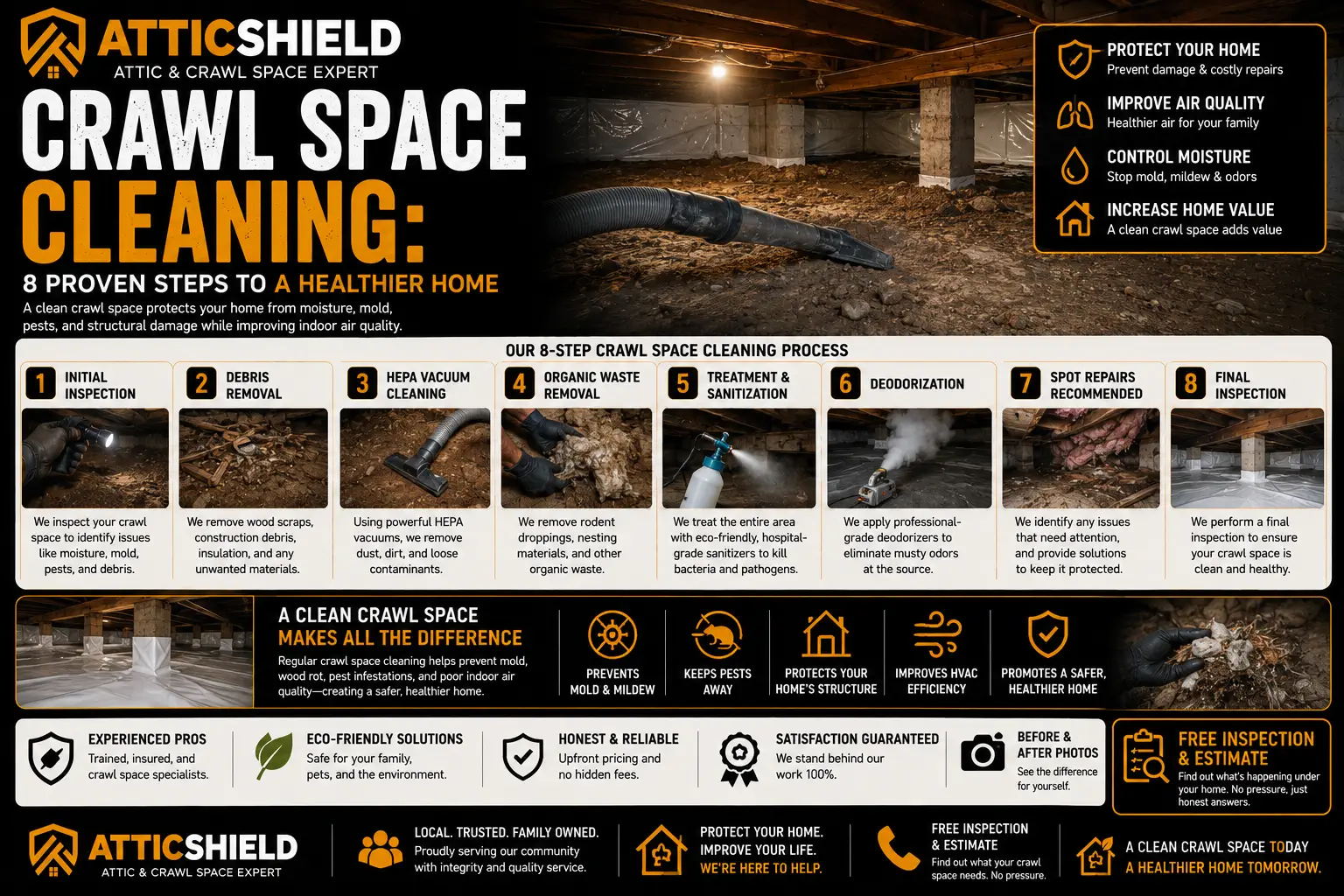
Crawl space cleaning sounds like a luxury until you learn what’s actually accumulated under the average raised-foundation home: decades of construction debris, fallen insulation, rodent waste, and dust — all sitting in a space that supplies air to the rooms above it. This guide covers what crawl space cleaning actually involves, what it fixes upstairs, when it’s the whole answer, and when it’s the first step of a bigger one.
Fair warning: the “what’s down there” section may send you to your access hatch with a flashlight. That’s the intended effect.

What’s in this guide
- What’s actually under your house
- Why it matters upstairs
- 7 signs it’s overdue
- The 8-step professional process
- When cleaning alone is enough
- When it’s step one of more
- What changes upstairs
- Cleaning and the home sale
- The DIY question, answered honestly
- Keeping it clean afterward
- Frequently asked questions
What’s Actually Under Your House
Nobody puts things in a crawl space on purpose — and yet every crawl space fills up. Here’s the standard inventory we find during crawl space cleaning projects across Southern California:
- Original construction debris. Lumber offcuts, drywall scraps, concrete chunks, wire, and packaging — left by the builders and every remodel since. Wood scrap on soil is also a standing invitation to pests.
- Fallen and shredded insulation. Batts that lost their fight with gravity, moisture, and rodents — a story we told in full in the crawl space insulation guide.
- Rodent evidence. Droppings, urine staining, nests, and the runways connecting them. Under-house spaces are sheltered rodent habitat, and per CDC guidance, the waste they leave requires careful handling — the single biggest reason crawl space cleaning is a protocol job rather than a chore.
- Dead vegetation, standing debris, and the occasional deceased animal — the source of “that smell” more often than homeowners want to know.
- Torn vapor barrier remnants — old plastic shredded and buried under the layers above it.
- Trash from past trades — bottles, wrappers, and abandoned materials from every service visit in the home’s history.
None of it does anything good, most of it holds moisture or shelters pests, and all of it sits upstream of your indoor air.
Why Crawl Space Cleaning Matters Upstairs
The case for crawl space cleaning isn’t tidiness — it’s the three ways the space’s condition reaches your living space:
- Air. Houses draw replacement air from low to high, and the crawl space is the lowest source — the stack effect we diagrammed in the vapor barrier guide. The EPA’s indoor air quality framework treats the pathways air travels as part of indoor air, and a debris-filled, contaminated crawl space is on the pathway. Musty odors “in the house” are frequently crawl space odors in transit.
- Pests. Debris piles and soft materials are harborage — cover and nesting stock for rodents and insects. Clearing them removes the habitat, which is why cleaning and rodent proofing are natural partners rather than separate decisions.
- Everything that comes next. No vapor barrier can be laid over debris; no insulation assessment is honest through a curtain of fallen batts; no inspection can map what it can’t see. Crawl space cleaning is the enabling step for the entire under-house scope — which is why crawl space cleaning leads every multi-service sequence we run down there.
7 Signs Crawl Space Cleaning Is Overdue
From the hatch — thirty seconds each
- You can’t see the soil for debris, fallen insulation, or scattered material.
- Musty or ammonia odor at the opening — moisture biology or rodent activity, respectively.
- Droppings anywhere in the beam of the flashlight.
- Insulation hanging from the joist bays — both a failure and a cleaning load.
- A smell inside the house that intensifies with humid weather or HVAC operation.
- Pest activity upstairs — the crawl space is the most common staging ground.
- You’re planning any under-house work — vapor barrier, insulation, ducts, plumbing, a home sale. Crawl space cleaning has to come first anyway; scheduling it consciously beats discovering it as a change order.
The 8-Step Professional Crawl Space Cleaning Process
Professional crawl space cleaning is a protocol, not a haul-out — here’s the sequence and why each step exists:
1. Inspection and documentation
Photos of the existing condition end to end — debris, contamination, insulation, moisture evidence, rodent evidence. This is both the work plan and your before-record, per the standard in what to expect from an inspection.
2. Containment and protection
The access route through your home protected, the opening contained — what comes out of a crawl space does not tour your hallway on the way to the truck.
3. Debris removal
Construction scrap, trash, vegetation, and abandoned materials bagged and extracted. The bulk phase.
4. Failed insulation removal
Fallen, damp, and contaminated batts out of the bays and off the soil — the insulation removal phase, which cleaning uncovers the true extent of.
5. Rodent waste removal
Droppings and nesting material handled to CDC-informed protocol — protective equipment, no dry sweeping, sealed disposal. The step that separates professional crawl space cleaning from a shop vac and optimism; it’s the same discipline as our attic-side waste removal service.
6. Sanitizing where contamination existed
Treated surfaces where rodent or moisture biology was active — neutralizing odor sources and scent trails rather than covering them.
7. The condition report
With the space finally visible: vapor barrier status, insulation verdict, entry points, duct condition, moisture sources — the findings that determine whether cleaning was the whole job or the first phase.
8. After-photos
The cleared space, documented — which doubles as pre-work condition proof for any home sale, per our home seller’s guide.
When Crawl Space Cleaning Alone Is Enough
Honestly: sometimes it is, and you deserve to hear when. Cleaning is the complete answer when the space is dirty but sound — debris and dust without active moisture, without rodent entry points, with an intact vapor barrier and serviceable insulation. The typical case: a home with decades of accumulated construction scrap, no odor, dry soil, and insulation still in its bays. Clear it, document it, done — and the space is ready for the next decade.
When It’s Step One of More
Cleaning uncovers; it doesn’t cure. Three findings routinely convert a cleaning into a sequence:
- Rodent evidence → exclusion. Cleaning removes the waste and the harborage; only sealing the entry points removes the rodents’ future. Skipping rodent proofing after finding evidence is scheduling a rematch.
- Bare or shredded barrier → vapor barrier. The moisture cycle that dirtied and damaged everything keeps running until the soil is covered — the full argument is in the vapor barrier guide.
- Failed insulation → replacement. Into the now-clean, now-dry, now-excluded space — the only environment where new material lasts, per the insulation guide.
The bundling economics are the same as everywhere else in this trade: mobilization, containment, and access get paid once, so the services that share them cost less together than apart — the logic detailed in our cost guide.
Before and After: What Crawl Space Cleaning Changes Upstairs
Because the work happens out of sight, homeowners reasonably ask what they’ll actually notice. The honest list, in the order people report it:
- The smell — first and most often. When the musty note that “lived in the house” turns out to have lived under it, crawl space cleaning removes it at the source within days. This is the single most common piece of feedback after the work.
- Night noises stop — where the cleaning ran with exclusion, the below-floor scratching ends because both the residents and the habitat are gone.
- Allergy-season indoors improves for some households — less contaminated air in the low-to-high flow means less of it arriving in bedrooms. We make no medical promises; we just note the air pathway is real, per the EPA framework above.
- Floors warm up — if insulation was part of the scope. Cleaning alone doesn’t re-insulate; cleaning plus the insulation sequence does, and winter mornings report it barefoot.
- The next trade’s bill shrinks. Plumbers and HVAC techs charge for the conditions they work in — a cleared, documented space is a faster, cheaper visit for every future service call.
Crawl Space Cleaning and the Home Sale
If a sale is anywhere on your horizon, the crawl space is on your buyer’s inspector’s checklist — and it photographs exactly as it is. Debris, droppings, and hanging insulation in an inspection report become repair credits negotiated under deadline, routinely at panic pricing; the same crawl space cleaning done calmly beforehand costs retail and comes with after-photos that turn a liability line into a maintenance story. The full playbook is in our home seller’s guide — the crawl space chapter is the one sellers skip and regret.
The DIY Question, Answered Honestly
Where DIY ends: rodent waste. The CDC’s handling guidance — no sweeping, no vacuuming, wet-methods, protection — exists because dry disturbance aerosolizes contaminants, and a tight crawl space is the worst possible room to do that in. If your flashlight finds droppings, the DIY project just changed categories.
For a genuinely clean-but-cluttered space with no contamination: hauling out debris yourself is real work but legitimate work. Go in with light, gloves, a dust mask at minimum, long sleeves, and a helper who knows you’re under there; watch for wildlife, low clearances, and anything electrical or plumbing you shouldn’t disturb. Most homeowners who start discover the far corners are where both the debris and the motivation problems live — which is the polite version of why this service exists.
Keeping It Clean Afterward
- A yearly flashlight look from the hatch — same calendar slot as your annual attic check. Thirty seconds confirms the barrier is positioned, the bays are full, and nothing new has moved in.
- After every under-house service visit, verify. Trades displace barriers and insulation; a quick look while the invoice is fresh keeps the fix on their tab.
- Treat new odors as messages. Must and ammonia at the hatch are the space’s only two ways of asking for help — both are cheapest the week you first notice them.
Frequently Asked Questions
What does crawl space cleaning include?
Debris removal, failed insulation removal, rodent waste removal to CDC-informed protocol, sanitizing where contamination existed, and a documented condition report — with containment protecting your home throughout. It’s the enabling step for vapor barrier, exclusion, and insulation work.
How often does a crawl space need cleaning?
Once done properly — with exclusion and a vapor barrier keeping the causes out — a crawl space stays clean for many years. The yearly hatch check is maintenance; repeat cleanings usually mean the causes were never addressed.
How long does crawl space cleaning take?
Most projects complete in a day; heavily loaded spaces or full sequences with barrier and insulation work run one to two days.
Is it safe to clean rodent droppings under my house myself?
Small incidental amounts, with strict CDC precautions — wet methods, never sweeping or vacuuming, gloves and protection. Accumulations in a confined crawl space are professional territory; the confinement is exactly what makes dry disturbance dangerous.
Will cleaning fix the musty smell in my house?
If the smell’s source is crawl space contamination or debris, yes — paired with the vapor barrier if soil moisture is feeding it. Cleaning removes the source rather than perfuming the symptom.
Do you clean crawl spaces and attics in the same visit?
Routinely — same house, same physics, same containment logic, opposite ends. One mobilization covering both is the efficient version, and the inspection covers both spaces either way.
See What’s Under There — Without Crawling
Crawl space cleaning reduces to one unfair fact: the crawl space is the part of your home you’re least likely to look at and most likely to be breathing. A free inspection settles what’s actually down there — photographed, explained, and separated into what needs doing now, what can bundle later, and what’s fine.
Free crawl space inspection, no obligation
Full photo documentation and a straight answer — cleaning alone, a sequence, or nothing at all. Serving San Diego County, Southwest Riverside County, and South Orange County.
Request your free inspection or call (858) 402-0066Attic Shield is licensed, bonded, and insured. CSLB #1138021, C-2 and B classifications. See our full service area.