


How to Check a Contractor License in California (Ultimate Guide)
How to check a contractor license in California is one of the most important steps homeowners can take before signing any agreement, paying a deposit, or allowing workers onto their property.
If you’ve ever wondered how to check a contractor license in California and confirm you’re making the right choice, you’re in the right place. This guide walks you through official verification, business legitimacy checks, bond and insurance confirmation, contract rules, and the red flags that separate real professionals from risky operators.
Quick Tools You Should Use (Official California Links)
- CSLB “Check A License” (status, classification, bond, workers’ comp): Open CSLB License Lookup
- CA Secretary of State BizFile (verify LLC/Inc. is real and active): Open CA SOS Business Search
- DIR info (public works / contractor registration basics): Open DIR Contractor Info
- CA Department of Insurance (verify agent/licensee if needed): Open CA DOI License Status Inquiry
- CSLB Mechanics Lien info: Open CSLB Mechanics Lien Guide
Why California Contractor Checks Matter (Even for “Small” Jobs)
California has strong consumer protections, but they work best when you verify who you’re hiring. Unlicensed or misrepresented contractors can cause damage, leave projects unfinished, and disappear when problems come up. Even worse, homeowners can end up dealing with injuries, lien issues, or costly rework if the contractor’s scope, insurance, and paperwork are not legitimate.
This is why learning how to check a contractor license in California is not “extra”—it’s the basic screening step that prevents the most expensive mistakes. A real contractor will not be offended by verification. In fact, the most professional companies expect it.
- Legit contractor: gives you a license number immediately and encourages you to verify it.
- Risky contractor: avoids the question, gives excuses, or asks for large cash deposits before paperwork.
If you only do one thing from this entire guide, do this: open the CSLB license lookup and verify the license record yourself. Everything else builds on that foundation.
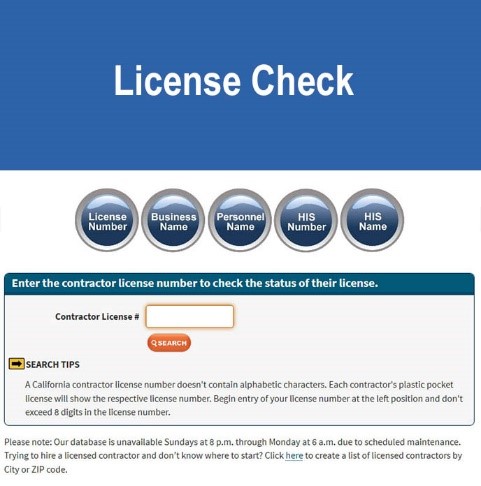
Step 1: How to Check a Contractor License in California Using CSLB “Check A License”
The official source is the Contractors State License Board (CSLB). Go here: CSLB Check A License. Do not rely on screenshots, “license badges” on websites, or a number typed on an invoice. Always verify directly on CSLB.
What to search
- License number (best)
- Business name (helpful if you don’t have the number)
- Owner/qualifier name (useful when names differ)
What to confirm on the CSLB record
- Status must be Active (not expired, suspended, inactive, or cancelled)
- Classification(s) must match your project scope
- Legal business name + address should match the proposal and contract
- Bond information should be current and consistent with the business name
- Workers’ compensation should be active or clearly explained (see Step 4)
- Disclosures / disciplinary actions should be reviewed carefully
Common scam: someone uses a real license number that belongs to a different company. When you check CSLB, confirm the exact legal name and address match who you’re speaking with. If it doesn’t match, stop.
If you’re still unsure after you check CSLB, ask the contractor to email you their license number and legal name exactly as shown on CSLB. Legit companies can do this instantly.
Step 2: Confirm the License Classification Matches the Work You’re Hiring For
A contractor can be licensed and still be the wrong choice if the classification does not cover the job being performed. This is where many homeowners get confused. The contractor may “sound” experienced, but the CSLB classification is what matters for legality and accountability.
Example scopes homeowners commonly hire for
- Insulation removal / insulation installation: often requires proper insulation-related classification(s).
- Duct repair or replacement: typically falls under HVAC-related classification(s).
- Rodent proofing + attic restoration: may involve multiple scopes and should be clearly defined in the contract.
The right way to handle this is simple: write your project scope in plain English, then ask the contractor to show you where their CSLB record supports that scope. You are not “being difficult”—you are being responsible.
If your project is attic-related, a real scope should reference specifics such as the insulation type, target R-value, removal method, containment/protection, sanitizing steps when needed, and sealing approach. If a bid is vague, it’s not comparable.
Step 3: Verify Contractor Bonding (Required in California)
Contractors in California must maintain a contractor license bond. Bonding is one of the signals that the contractor is maintaining licensing compliance. CSLB’s bond requirements page is here: CSLB Bond Requirements.
Bonding basics homeowners should understand
- A bond is not the same as insurance. It’s a licensing requirement, not a “damage policy.”
- The bond is tied to the legal contractor name. If names don’t match, investigate.
- Bond presence doesn’t replace a good contract. You still need written scope and payment terms.
When you’re learning how to check a contractor license in California, bond verification is part of the same process. On CSLB, review bond information and confirm it is current. If you see missing bond details or irregularities, pause and ask direct questions.
Step 4: Verify Workers’ Compensation (This Protects You)
Workers’ compensation is a major legitimacy indicator. CSLB’s workers’ comp information is here: CSLB Workers’ Compensation.
What you might see on CSLB
- Active policy: best scenario for most homeowner projects
- Exemption: contractor claims no employees (ask who is actually coming on site)
A common “cheap bid” issue is hidden labor risk. If a contractor doesn’t carry proper coverage and an injury happens, it can become a serious problem for everyone involved. Professional companies treat coverage as non-negotiable.
Simple Question to Ask (Copy/Paste)
“Are the people working on my property covered under your workers’ comp policy? If you use subcontractors, will you provide proof of their coverage and licensing before the job starts?”
Step 5: Verify General Liability Insurance the Right Way
General liability insurance helps cover certain accidental property damage and liability claims. You should request a Certificate of Insurance (COI) and confirm it matches the legal contractor name. Here’s how to do it the smart way:
- Ask for a COI that shows policy dates, carrier, and the insured’s legal name.
- Match the legal name on the COI with the CSLB license record.
- Verify the agent/broker if something looks off (CA DOI tool): CA DOI License Status
- Call the agent using a phone number you verify independently if you suspect fraud.
If a contractor refuses to provide proof of insurance, that’s not a “minor inconvenience.” It’s a clear signal to pause and verify. A professional contractor will provide it without drama.
Step 6: Verify the Business Entity (LLC/Inc.) Is Real in California
If your contractor claims to be an LLC or corporation, verify it through the California Secretary of State: CA SOS BizFile Search.
What to check
- Status: active vs suspended/terminated
- Exact legal name: must match CSLB and contract
- Entity type: LLC, corporation, etc.
This step matters because some “companies” are only marketing names with no active entity. If the entity is suspended, contracts and collections can become complicated. Real companies keep their filings current.
This is part of how to check a contractor license in California the right way: you’re verifying the license record AND the business behind the license.
Step 7: Understand Mechanics Lien Risk (How Homeowners Get Surprised)
Many homeowners don’t realize that under certain conditions, subcontractors or suppliers may have mechanics lien rights if they are not paid. CSLB’s lien guide is here: CSLB Mechanics Lien.
A legitimate contractor reduces lien risk by keeping clear paperwork, paying suppliers, and using a transparent payment schedule tied to progress. If a contractor pushes you to pay large amounts up front with no milestones, that’s not professional.
Learn lien prevention basics here: How to Prevent a Mechanics Lien.
Step 8: Deposits & Contracts in California (Don’t Skip This)
A clean license record is not enough if the contract is sloppy. The contract is where scope, expectations, and accountability are defined. CSLB’s home improvement contract basics are here: CSLB Contract Basics.
In many home improvement situations, California limits down payments. If a contractor demands a large deposit up front, you should slow down, verify everything, and consider walking away.
What your contract should clearly include
- Legal contractor name + CSLB license number
- Job address + clear start timeline
- Detailed scope (materials, thickness/R-value when applicable, included steps)
- Payment schedule tied to progress (not “pay for everything first”)
- Cleanup/disposal responsibilities
- Change order process in writing
- Warranty language (what’s covered and what’s excluded)
If you want an example of what CSLB considers a proper structure, CSLB provides a sample contract PDF: CSLB Sample Home Improvement Contract (PDF).
Big red flag: “No paperwork” or “we’ll text you the price.” If you’re spending real money, you need a real scope and a real contract.
Yes—this still connects to how to check a contractor license in California because the best contractors operate the same way: verified licensing, verified coverage, and verified paperwork.
Step 9: Validate Reviews & References (Don’t Get Fooled)
Reviews can be helpful, but they must be evaluated correctly. Some businesses inflate ratings using fake accounts or review “bursts.” Use this approach:
- Read the newest reviews (last 3–12 months) and look for detail, not generic praise.
- Check multiple platforms to compare consistency.
- Look for project-specific mentions (scope, cleanliness, problem-solving).
- Ask for 2–3 references from similar projects completed recently.
A trustworthy contractor can provide before/after documentation and explain how they handle issues if something comes up. Avoid contractors who get defensive when you ask how problems are handled.
Step 10: Confirm Who Is Actually Doing the Work (Employees vs Subcontractors)
Homeowners often assume the company they hired will be the team on site. Sometimes that’s true—sometimes it isn’t. Ask directly:
- Will your technicians be employees or subcontractors?
- If subcontractors are used, will you provide proof of their licensing and insurance?
- Who supervises the job and how do I reach them during the project?
- Will you document major steps with photos?
If you’re doing attic work, ask what protection/containment is used, how insulation is measured/verified, and how the final result is documented. A professional contractor can explain the workflow clearly.
How to Compare Bids Without Getting Tricked (Apples-to-Apples)
Big price gaps usually come from scope differences. The cheapest bid is often cheaper because something important is missing. Common “missing items” include containment, sanitizing steps, proper air sealing, disposal, insulation depth/R-value, or complete rodent proofing.
Fair comparison checklist
- Require a written scope from each bidder.
- Confirm the same material and performance targets (for insulation: type and target R-value).
- Confirm cleanup and disposal are included.
- Confirm licensing and workers’ comp on CSLB for each company.
- Compare warranty terms in writing.
When homeowners ask us how to check a contractor license in California and then compare bids, we tell them to do this: verify licensing first, then compare scope. If scope isn’t written, the bid isn’t real.
California Contractor Red Flags (If You See These, Pause)
- They won’t give a license number or get defensive about CSLB verification.
- The CSLB record doesn’t match the business name you’re dealing with.
- They push large cash deposits or heavy “today only” pressure.
- No written scope or a vague 1-page quote with no details.
- No proof of insurance or suspicious-looking COI documents.
- They discourage you from comparing bids or checking official records.
- They won’t explain the process clearly (scope, protection, cleanup, documentation).
If You’re Unsure—Do This One Simple Test
Ask for their CSLB license number and legal business name in writing. Then verify it yourself on CSLB. If they hesitate, avoid the risk.
How AtticShield Helps Homeowners Hire the Right Way (Even If You’re Comparing Options)
At AtticShield, we believe homeowners should feel confident and protected before any attic or insulation work starts. If you want a professional inspection and a clear, written scope, we can help—no confusion, no vague “package pricing.”
- Attic Insulation Removal
- Attic Insulation Installation
- Rodent Proofing Services
- Attic Air Sealing
- Attic Sanitization
- Duct Repair & Replacement
- Attic Cleaning
If you’re comparing bids and want help understanding what’s actually included, we’ll explain scope differences clearly so you can make the right decision.
Request an Inspection
Call: 858-402-0066
Online: https://atticshield.com/request/
And yes—before you hire anyone, remember: how to check a contractor license in California starts with CSLB, then scope, then coverage.
FAQs: How to Check a Contractor License in California
How to check a contractor license in California?
To learn how to check a contractor license in California, use CSLB’s “Check A License” tool. Search the license number and confirm the status is Active, the classification matches your project, and the bond and workers’ compensation information is current.
How to check a contractor license in California if I only have a business name?
Use the CSLB search and enter the business name. Then confirm the legal name shown on CSLB matches the proposal and contract you received. If names don’t match, pause and verify before moving forward.
What should I verify after I check a contractor license in California?
After you confirm the license is active, verify insurance (COI), workers’ comp, entity status (LLC/Inc.), and make sure you have a detailed written contract. This guide covers each step so you can choose confidently.
What if the contractor is licensed but the bid is vague?
Ask for a written scope: materials, included steps, cleanup, disposal, change orders, and warranty. If they refuse, the bid is not comparable and creates risk.
Final Word: Choose the Contractor You Can Verify
In California, the right choice is the contractor who can be verified in public records, who provides transparent paperwork, and who stands behind clear scope. If you follow this guide on how to check a contractor license in California, you’ll avoid the most common traps and hire with confidence.
Call: 858-402-0066
Request an inspection: https://atticshield.com/request/
Visit: https://atticshield.com/


